Pay in installments of $6.36 with
 ,
,
 and
and

Shipping Estimate
USA
- USA
- CAN
- USA
- CAN
Ships within 48 hours · Estimated delivery Sep 25 - Sep 30
 Promo Codes Available:
For Your Every Summer RSVP, with Code: SUMMER15
Description
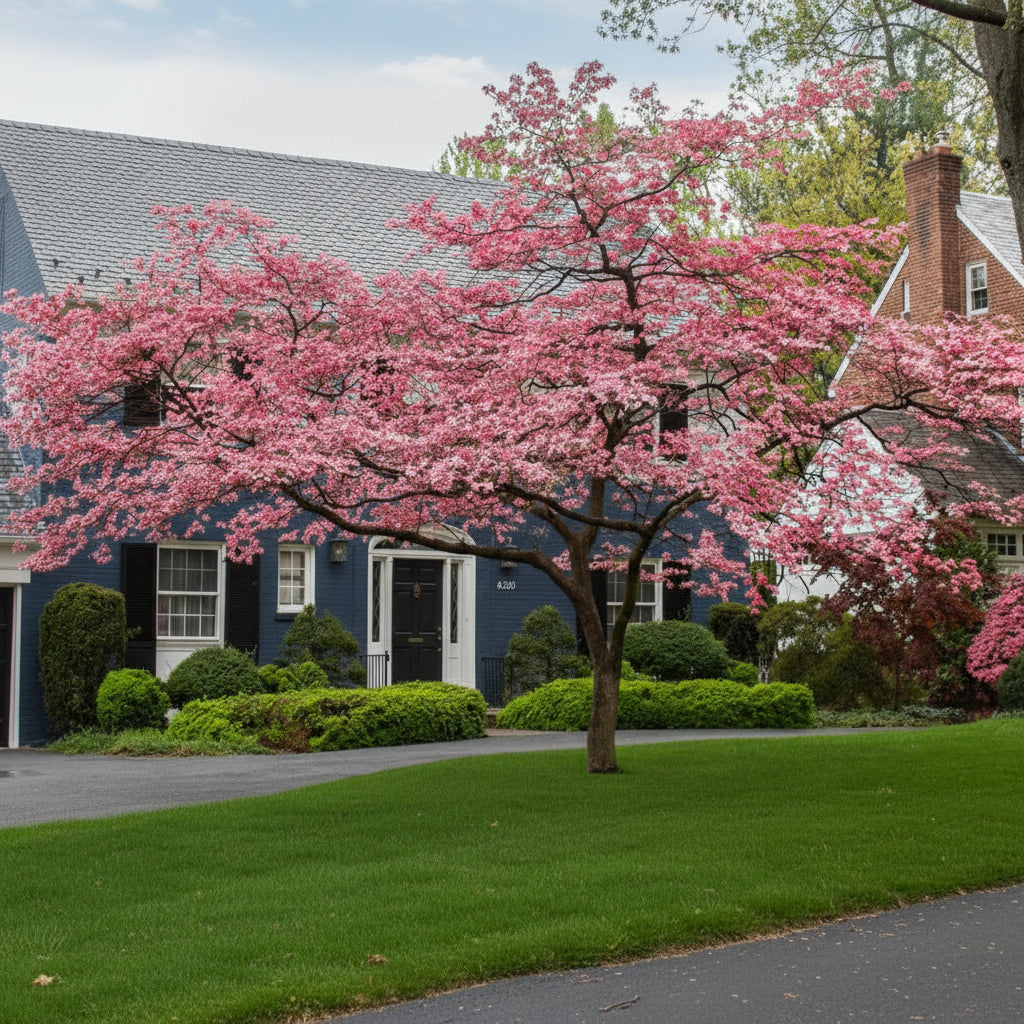
can you plant a dogwood next to your house Red Flowering DogwoodThe native red flowering dogwood (Cornus florida f. rubra) delivers all the architectural grace and four season beauty of the white flowering dogwood, but with showy pink to reddish pink bracts that bring color to the garden. While most wild dogwoods display classic white bracts, this naturally occurring formfirst documented by Mark Catesby in Virginia in 1731 [1] turns up occasionally in the wild with its blushing pink to rosy red display. Reaching
The native red flowering dogwood (Cornus florida f. rubra) delivers all the architectural grace and four-season beauty of the white flowering dogwood, but with showy pink to reddish-pink bracts that bring color to the garden. While most wild dogwoods display classic white bracts, this naturally occurring form—first documented by Mark Catesby in Virginia in 1731 [1] —turns up occasionally in the wild with its blushing pink to rosy red display.
Reaching 15 to 30 feet tall with an equal spread, the red flowering dogwood develops the signature horizontal branching pattern that gives flowering dogwoods their distinctive layered architecture. The lower branches grow horizontally while upper branches reach more upright, creating a broadly pyramidal but somewhat flat-topped form that lends striking horizontal lines to the landscape. Dark green opposite leaves with gracefully arching veins provide elegant summer texture, then transform to vibrant reds and purples in fall. Glossy red berries clustered in groups of 3 to 4 ripen by late summer and persist through early winter. As the tree matures, its bark develops the characteristic alligator-hide pattern of small, blocky squares that provides winter interest even after the leaves have fallen.
This native beauty excels as an understory specimen or small shade tree near patios, along streets, or as a property accent. Plant in well-drained, organically rich, slightly acidic soil and maintain a 2 to 4 inch layer of mulch to keep roots cool and moist. The red flowering dogwood pairs beautifully with evergreens, larger shade trees, or as a stunning contrast to white-flowering dogwood cultivars. Its moderate size makes it manageable for most residential landscapes.
The red flowering dogwood is not a cultivar but rather a naturally occurring botanical form (forma rubra) of our native Cornus florida. While numerous named pink-bracted cultivars have been selected and propagated over the years—including 'Cherokee Chief', 'Sweetwater Red', and 'Spring Song'—the straight species red form shows natural variation in color intensity from soft pink to deep reddish-pink. This variation reflects the genetic diversity within wild populations, where the red trait occasionally appears as a spontaneous mutation. The forma rubra designation simply identifies this color variant occurring in nature, distinguishing it from the more common white-bracted form.
Like all native flowering dogwoods, the red form serves as an ecological powerhouse in the landscape. According to Dr. Doug Tallamy's research, Cornus florida supports an impressive 117 species of Lepidoptera (butterflies and moths), providing essential caterpillar food for songbirds raising their young [2]. The Spring Azure butterfly uses dogwood as a larval host plant, while specialized native mining bees—including Andrena fragilis, Andrena integra, and Andrena platyparia—depend on dogwood flowers for pollen and nectar. The glossy red berries are eagerly consumed by numerous songbird species including thrushes, cardinals, tufted titmice, grosbeaks, thrashers, and bluebirds, as well as wild turkey, ruffed grouse, and quail. Flocks of American robins often move systematically through landscapes as dogwood berries ripen from forest edges inward. Mammals including chipmunks, squirrels, black bears, gray foxes, and white-tailed deer also feast on the berries from September through February, helping distribute seeds across the landscape. By planting a red flowering dogwood, you're not just adding a beautiful ornamental tree—you're establishing a native keystone species that supports hundreds of other organisms throughout the year.
[1] Santamour & McArdle, 1985. "Cultivar Checklists of the Large-Bracted Dogwoods," Journal of Arboriculture 11(1):29-36.
[2] Tallamy, D.W. "Not In Our Yard," Homegrown National Park
[3] USDA Forest Service Fire Effects Information System, Cornus florida
Shipping Notes
- Free Standard Shipping on $100+ Orders to the USA.
- Except Preorder products are shipped in 48 hours.
- Delivery to the USA:
- Standard Shipping : 3-10 business days
- If time is of the essence, please consider selecting expedited delivery for faster service.
Exchange/Return Notes
- We offer a 30-day return/exchange service after receiving.
- Final sale items are not eligible for returns or exchanges.
- To process your return/exchange, please contact us at [email protected]
- Please click here for more details>>> Return & Exchange Policy