SKU: 13201856883
bonsai bright tree

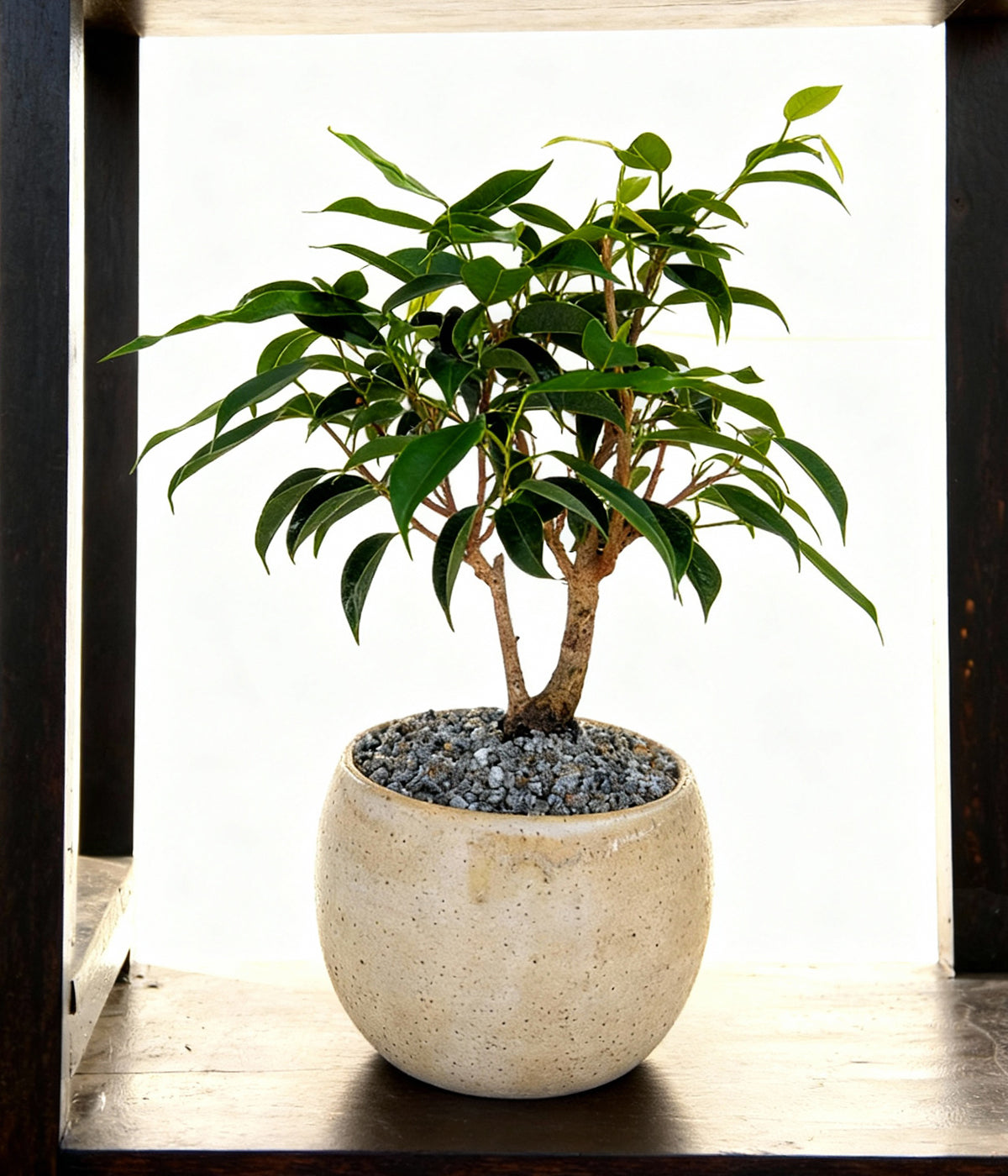
bonsai bright tree Weeping Fig Bonsai Tree

Sale price$26.50 Regular price$29.45
Save 10%

Pay in installments of $7.36 with ShopPay, AfterPay and Klarna

Shipping Estimate
USA
  • USA
  • CAN

Ships within 48 hours · Estimated delivery Sep 25 - Sep 30

Promo Codes Available:

For Your Every Summer RSVP, with Code: SUMMER15

Description

bonsai bright tree Weeping Fig Bonsai TreeFicus benjamina Weeping Fig Bonsai Plant Indoor Ficus Benjamina Native to Southeast Asia and Australia, the Weeping Fig grows tall in the wild but adapts beautifully to indoor spaces when shaped and maintained. Its slim trunk branches into a canopy of glossy leaves, creating an airy silhouette that brings natural rhythm to living and working areas. Each tree is set in a hand crafted Speckled White vessel with a soil blend designed for balanced

Ficus benjamina

Weeping Fig Bonsai Plant | Indoor Ficus Benjamina

Native to Southeast Asia and Australia, the Weeping Fig grows tall in the wild but adapts beautifully to indoor spaces when shaped and maintained. Its slim trunk branches into a canopy of glossy leaves, creating an airy silhouette that brings natural rhythm to living and working areas. Each tree is set in a hand-crafted Speckled White vessel with a soil blend designed for balanced moisture and root health.

Dwarf Tree | Easy Care Indoor Bonsai for Home and Office

Bright conditions suit this bonsai best—full natural light or bright, indirect sun. Water when the pot feels lighter, typically every 5–7 days: submerge up to the rim for 5–10 minutes, then drain fully. Keep away from heaters, AC units, and sudden temperature shifts. Once outdoor temperatures stay above 55°F, it can spend time outside in gentle morning light, protected from intense afternoon sun. Light pruning twice a year maintains its form.

Small Ficus Tree | Versatile Desktop and Shelf Plant

This bonsai fits easily on a bedside table, bookshelf, kitchen island, or work desk. The rounded Speckled White vessel adds a sculptural element that pairs well with ceramic frogs, books, and decorative accents with natural textures. Whether bringing greenery to small apartments, softening office corners, or serving as a thoughtful gift, the Weeping Fig complements a range of interior styles.

Ficus species are often associated with focus, steady development, and long-term growth. In various traditions, they symbolize resilience and thoughtful progression—qualities that make them meaningful additions to workspaces or personal areas.

IN A NUTSHELL

Thrives in bright or bright-indirect natural light; protect from harsh sun and direct heat.

Low to moderate maintenance. Water when the pot feels about half lighter—about every 5–7 days—by submerging up to the rim for 5–10 minutes and draining well.

Prefers temps between 55–80°F; may be placed outdoors in mild weather with gentle morning light.

Light pruning twice a year keeps its canopy shaped and proportionate.

All live plants are non-returnable / non-refundable / not eligible for discounts.

Shipping Notes
  • Free Standard Shipping on $100+ Orders to the USA.
  • Except Preorder products are shipped in 48 hours.
  • Delivery to the USA:
  1. Standard Shipping : 3-10 business days
  • If time is of the essence, please consider selecting expedited delivery for faster service.
Exchange/Return Notes
  • We offer a 30-day return/exchange service after receiving.
  • Final sale items are not eligible for returns or exchanges.
  • To process your return/exchange, please contact us at [email protected]
  • Please click here for more details>>> Return & Exchange Policy
SKU: 13201856883

Discover Niche Categories That Outsell bonsai bright tree

Top-Converting Item to Boost Your Average Order

4.9 ★★★★★
Based on 13 reviews
Sort
Highest Rating
Newest First
Oldest First
Product Reviews
K
Verified Purchase
Khatuna Brady
Draper, US
★★★★★ 2
A masterfully falsified history of the late Soviet developments
Format: Paperback
This book represents academic propaganda, providing some interesting insights into important events. Some details are true, but some crucial details are omitted. It represents a sanitized version of Russia's modern history. It provides misleading information about Gorbachev's constitutional reforms, aimed at partitioning of 15 republics into 53 confederation entities. Originally, the targeted republics were Kazakhstan, Moldova, Georgia, Azerbaijan, Ukraine, etc. Those conflicts were manufactured by the Soviet center to discredit "nationalists," facilitate the partition of national republics, and grant Moscow right to protect ethnic minorities. According to Starovoitova, Bakatin, Yakovlev, and a few other primary sources, the Soviet security services led special operations in the Caucasus and Central Asia to provoke those conflicts. Zubok avoids citing those parts. Using the imperial approach of "divide and rule," Moscow attempted to become a peacekeeper in the conflicts it created between different ethnicity. In addition to fragmenting the republics with well-developed national identities, Gorbachev's new constitution would revoke their right to leave the USSR, written in Lenin's 1922 Constitution (Shakhnazarov, 1992). Zubok does not explain any of it. His book is an effort to protect the truth and conceal facts with Russian myths and lies about nationalism (also referred to as Nazism). Notably, Zubok does not recognize non-Russian republics and describes them as "territories." He mentions Pitsunda as a resort on the Black Sea, not as Georgia. For lying about the genocidal ethnic cleansing conducted by the Russian military against the Georgian population of Abkhazia, Zubok owes apology to the victims of conflicts and wars initiated by Gorbachev and carried on by Yeltsin. The story about "the hardliners coup against Gorbachev" is also a big fat lie. American scholars, Amy Knight, John Dunlop, and William Odom provide more accurate insights. For Russian sources, read Marshal Shaposhnikov or Aleksandr Lebed's memoirs (1995) and listen to Gennady Yanaev's interview (2009). According to Mitrokhin archives (original), the August 1991 coup was an active measure the KGB developed per Gorbachev's request. The so-called coup was part of Gorbachev's constitutional reform, which would lead to the removal of unfriendly leaders (including Yeltsin) from the republics. It failed because the Soviet military brass, foremost Pavel Grachev, had defected to Yeltsin earlier in 1991. When you read a book by a seasoned Russian propagandist, like Zubok or Trenin, take it with a grain of salt, because it will always contain a mix of lies and truth.
WAS THIS REVIEW HELPFUL?YesReportShare
Reviewed in the United States on March 16, 2023
U
Verified Purchase
Ujjval K. Vyas
San Leandro, US
★★★★★ 5
An important work and worth the time.
Format: Hardcover
Real scholarship addressing difficult but important topics in history, economic history, and development. What every economist should read to think much more deeply about how institutions, culture, and human agency interact. At the same time, scholars like the three co-authors demonstrate that there still remains the possibility of doing work that isn’t larded with ideological or activist posturing. Highly recommended.
WAS THIS REVIEW HELPFUL?YesReportShare
Reviewed in the United States on May 5, 2026
H
Verified Purchase
Hal in Bloomington, Indiana
Boise, US
★★★★★ 5
Excellent research and well written by a Noble Laureate
Format: Hardcover
Excellent research and well written.
WAS THIS REVIEW HELPFUL?YesReportShare
Reviewed in the United States on December 10, 2025
D
Verified Purchase
David Freshwater
Waukegan, US
★★★★★ 2
should have been shorter
Format: Hardcover
really interesting approach - but far too wordy
WAS THIS REVIEW HELPFUL?YesReportShare
Reviewed in the United States on February 3, 2026
T
Verified Purchase
T
Phoenix, US
★★★★★ 5
6 year old loves these books
Format: Paperback
One of my son’s favorite book series.
WAS THIS REVIEW HELPFUL?YesReportShare
Reviewed in the United States on May 1, 2026

recommand products