SKU: 21331525224
caring for portulacaria afra

caring for portulacaria afra Elephant Bush

Sale price$20.81 Regular price$23.12
Save 10%

Pay in installments of $5.78 with ShopPay, AfterPay and Klarna

Shipping Estimate
USA
  • USA
  • CAN

Ships within 48 hours · Estimated delivery Aug 30 - Sep 4

Promo Codes Available:

For Your Every Summer RSVP, with Code: SUMMER15

Description

caring for portulacaria afra Elephant BushIntroducing the Elephant Bush, also known as Portulacaria afra, which is a fascinating and popular succulent garden plant native to South Africa. It belongs to the Portulacaceae family and is known for its unique appearance and easy care requirements. The elephant bush succulent gets its name from its resemblance to the foliage of an elephant's trunk. It is also commonly referred to as the dwarf jade plant, small leaf jade, miniature jade, elephant

Introducing the Elephant Bush, also known as Portulacaria afra, which is a fascinating and popular succulent garden plant native to South Africa. It belongs to the Portulacaceae family and is known for its unique appearance and easy-care requirements.

The elephant bush succulent gets its name from its resemblance to the foliage of an elephant's trunk. It is also commonly referred to as the dwarf jade plant, small leaf jade, miniature jade, elephant food, or the Spekboom. The name "Dwarf Jade Plant" comes from its small, jade-like leaves, while "Spekboom" is an Afrikaans term meaning "bacon tree" due to the plant's edible leaves that reportedly taste like bacon.


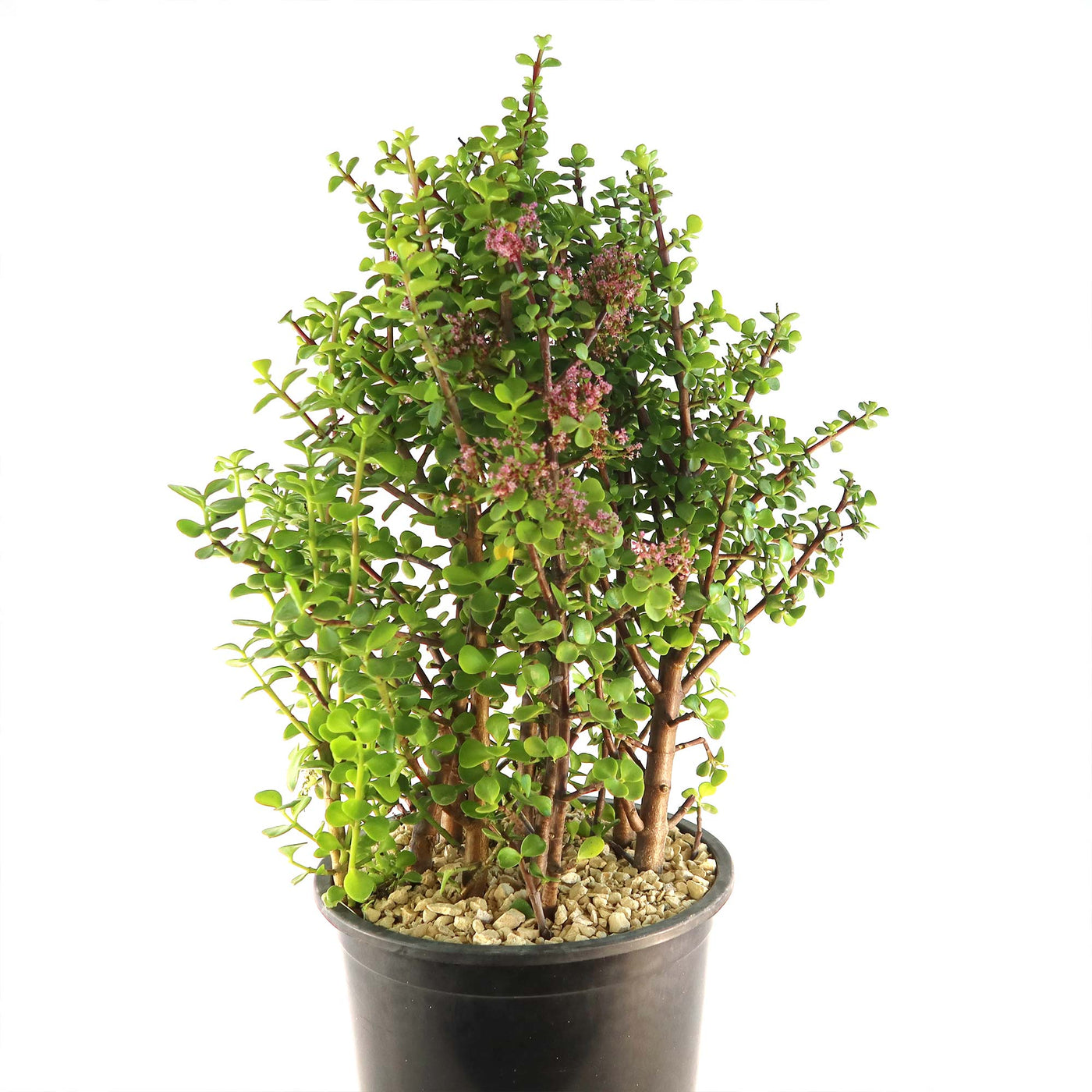
The elephant bush plant features small, round, and fleshy pale green leaves that store water, allowing your elephant bush plant to withstand drought conditions. 

The trailing stems of the elephant bush plants are thick and red-hued, which gives them a unique and appealing appearance in hanging baskets.

When grown as a houseplant, the elephant bush typically reaches a height of 1 to 3 feet.

However, if planted outdoors in its native habitat, your Portulacaria afra can grow much larger, reaching heights of up to 20 feet. The elephant bush makes for an excellent bonsai due to its unique growth pattern and ability to withstand pruning. Its thick, fleshy leaves and sturdy branches give it a robust appearance, making it an ideal succulent for shaping into intricate bonsai designs. 

The elephant bush flowers are small, star-shaped, and usually a light pink or lavender color. While the flowers are not the main attraction of this elephant bush succulent, they can add a touch of beauty when they bloom during the spring to late summer.

The elephant bush Portulacaria afra comes in various varieties, including a slow-growing variegated form Portulacaria afra variegata; a trailing growth bush Portulacaria afra prostrata; and a midstripe rainbow bush Portulacaria afra medio-picta, offers a diverse range of beauty in green spaces.

When and How to Water Your Elephant Bush

Like other drought-tolerant jade plants, your elephant bush succulent prefers a watering routine that allows the soil to dry out between waterings. Overwatering can harm the elephant bush plant and cause root rot.

In the summer, during the growing season, you should water elephant bush succulents once or twice a month when the soil is dry. A good rule of thumb is to water this elephant plant when the top 1-2 inches of soil feel dry to the touch. In the winter, during the dormant period,  you probably do not need to water them at all. 

Remember, it's always better to underwater than to overwater the elephant bush plant. This resilient Portulacaria afra plant can tolerate drought conditions better than excessive moisture. So, keep an eye on the soil moisture and adjust your watering schedule accordingly.

Light Requirements - Where to Place Your Elephant Bush Plant

When growing the elephant bush indoors, it thrives in bright, indirect light. Place your elephant bush plant near a window where it can receive plenty of natural bright light, but make sure to avoid direct sunlight, especially during the hottest parts of the day.

If you notice the leaves turning yellow or getting scorched, it's a sign that the Portulacaria afra elephant bush is receiving too much direct sunlight. So, finding that sweet spot of bright, indirect light is key to keeping your elephant bush succulent plant happy indoors.

If you decide to grow your elephant bush outdoors, it loves basking in the full sun. Although partial shade in the afternoon is frequently preferred, these plants need at least six hours of strong light each day to survive.

This is true, especially in hotter climates where the plant may become stressed by the afternoon sun's intense heat.

Your succulents should not be placed in any areas that receive continuous, direct sunlight, as this could lead to burned foliage.

Remember, the elephant bush is a versatile succulent plant and can adapt to different light conditions. Just keep in mind that it prefers bright, indirect light indoors and full sun to partial shade outdoors.

Optimal Soil & Fertilizer Needs 

Elephant succulents are very airy, porous, nutrient-rich well-drained soil with a pH of 5.5- 6.5; succulents require fast-draining soil that dries completely between waterings. Your soil must have a sandy texture and a low water-holding capacity, just like desert soil.  Ideally, you want to use our specialized succulent potting mix that contains 5 natural substrates to promote the development of a strong root system that helps your African elephant bush plant to thrive.   

When it comes to fertilizing your elephant bush plant, it only needs a small amount of fertilizer applied once a year in spring. These succulents prefer a fertilizer with lower doses of NPK, with a maximum ratio of 5-10-5 that is higher in phosphorus than nitrogen.

Hardiness Zones & More 

When it comes to growing the Elephant Bush plant indoors, the Elephant Bush prefers a cozy environment with temperatures between 65°F and 75°F. It can tolerate slightly cooler temperatures, but it's best to avoid extreme cold or frost. If you notice the leaves starting to shrivel or the tips turning brown, it may be a sign that the air is too dry. You can increase humidity by placing a tray of water near the plant or using a humidifier.

If you are living in USDA zones 9-11, you can grow your Elephant Bush plant outdoors year-round. These zones have mild temperatures and are less prone to frost.  

In cooler zones, it can be kept outdoors during the summer and brought in as the temperature drops. 

Elephant Bush can handle average to slightly higher humidity levels outdoors. Just make sure to provide well-draining soil to prevent waterlogged conditions, as excessive moisture can lead to root rot.

Don't worry if your succulents become too hot; they can tolerate triple-digit temperatures in the summer and prefer constant temperatures above 70 degrees Fahrenheit. 

Wildlife - Portulacaria afra Attracts the Following Friendly Pollinators

Portulacaria afra have tiny, star-shaped flowers, which bloom in clusters, and are a magnet for friendly pollinators. Bees are particularly drawn to its nectar-rich blooms, while butterflies and other beneficial insects are also frequent visitors. In areas where it thrives outdoors, hummingbirds may be attracted to the vibrant blossoms as well. 

Butterflies
Bees
Hummingbirds
Lady Bugs
Multi Pollinators
Other Birds

According to ASPCA, the Portulacaria afra Elephant Bush is friendly to both humans and pets such as dogs and cats. This makes it a great choice for households with curious pets or small children.

How to Propagate Your Portulacaria afra

This African elephant bush is relatively easy to propagate. It can be grown from stem cuttings, which should be allowed to dry for a day or two before being planted in well-draining soil. The cuttings usually root quickly and can be grown into new, young plants.

Key Takeaways

  1. Elephant Bush (Portulacaria afra) is a fantastic succulent with small, jade-like leaves.
  2. Visually appealing and easy to care for, adaptable for both indoor and outdoor growth.
  3. Tolerates a wide range of warm temperatures, between 65°F and 75°F, and handles higher humidity levels.
  4. It can thrives in bright, indirect light. It is suitable for beginner and experienced plant enthusiasts alike.
  5. Often grown as a seasonal accent plant or houseplant.
  6. Order your Elephant Bush today and add something truly exceptional to your garden.

The Bottom Line

Overall, Portulacaria afra, or Elephant Bush, is a remarkable plant that combines beauty, resilience, and ecological value. Its succulent, jade-like leaves and sprawling growth make it a striking addition to both indoor and outdoor settings, while its ability to tolerate drought and thrive in poor soils underscores its low-maintenance appeal. This plant’s capacity to attract friendly pollinators such as bees and butterflies further enhances its value in promoting biodiversity. With minimal care—bright, indirect light, well-draining soil, occasional watering, and protection from frost—Portulacaria afra can flourish for years, serving as both a stunning decorative element and an eco-friendly choice for any garden or home.

Shipping Notes
  • Free Standard Shipping on $100+ Orders to the USA.
  • Except Preorder products are shipped in 48 hours.
  • Delivery to the USA:
  1. Standard Shipping : 3-10 business days
  • If time is of the essence, please consider selecting expedited delivery for faster service.
Exchange/Return Notes
  • We offer a 30-day return/exchange service after receiving.
  • Final sale items are not eligible for returns or exchanges.
  • To process your return/exchange, please contact us at [email protected]
  • Please click here for more details>>> Return & Exchange Policy
SKU: 21331525224

Discover Niche Categories That Outsell caring for portulacaria afra

Top-Converting Item to Boost Your Average Order

4.0 ★★★★★
Based on 6 reviews
Sort
Highest Rating
Newest First
Oldest First
Product Reviews
K
Verified Purchase
KD Gibbs
San Leandro, US
★★★★★ 4
Entertaining, stats go burr, some annoying writing quirks
Format: Audiobook
This series is like following along your favorite video game MC. It has a decent amount of plot, although there occasionally is too much tangential action before resolving a plot. Don't expect amazing depth and you'll be pleasantly surprised by how mindlessly entertaining this story is. Yes, the male MC is so lucky that he survives everything even without a clever plan (ever) but at least the author kinda explains this with a high luck stat. It's basically an in-world explanation for plot armor, which I kinda respect in its audacity. That said, two complaints: 1) As a biologist, it's annoying to hear the myth that the "law of the jungle" is "only the strong survive" as the "way of nature" repeated over and over. This is an old fashioned and inaccurate understanding of evolution, which is primarily about survival of populations and certainly has selection at multiple levels (genes, individuals, familial groups, & populations). The idea that the system's goal of "strongest survive" in this novel producing anything like evolution is an annoying and persistent reminder of how poorly most people understand evolution. Fitness is defined by how well an organism matches its niche and how many offspring it has, not how many it kills or how strong it is. So if a cultivator in this novel becomes amazingly powerful and has zero kids, they would be a total unfit creature as defined by evolution. To add on, "law of the Jungle" understood as "every man for himself" is also an old misunderstanding of Kipling, who was actually making a point that even animals in nature follow some rules, after all "the strength of the Pack is the Wolf, and the strength of the Wolf is the Pack". It has always baffled me how such a small scale collectivist phrase has been so thoroughly misunderstood my our individualistic culture. 2) The author has several annoying writing quirks, like needlessly using the word "itself" all the time. Similarly, adjectives are heavily repeated. Author favorites are "powerhouse" & "monster". It makes no sense that every culture would have the same slang and it's annoying to hear the same words so often. Might I suggest a thesaurus? It's fine if Ogras always says "monster" but everyone can't do that or it just seems like the author has limited vocab. On that note, too many things are described as near endless, limitless, etc. That is a nonsensical concept, which covers for not explaining something in measurements or metaphors. This is a common issue with authors who don't do math, but something "near" infinite, is actually infinitely far from infinite. Something is infinite or it's not. Again, lets find other terms like "vast" or "enormous." Or get even better and say something "stretched across a province/country/continent/planet/solar system/galaxy/etc". Those all provide size without saying something nonsensical. 2) Stats go burr to the point of confusion. We're supposed to track attribute points, Dao, race, core, skills, nodes, bloodline & bloodline skills. We need more charts at the beginning of each book. How about one showing how skills merged? And what's the difference between 50 and 100 strength. How about 1000 or 10,000? It'd be nice had even rough comparison to picking up some mass like 100 strength means picking up a car and 1,000 is picking up a mountain.
WAS THIS REVIEW HELPFUL?YesReportShare
Reviewed in the United States on November 20, 2024
E
Verified Purchase
Eli
West Palm Beach, US
★★★★★ 5
Outstanding litrpg novel
Format: Kindle
Sympathetic, proactive protagonist; good pacing; good dialog; good progression; believable secondary characters. The rules of the magic system are introduced gradually, so there isn’t a huge boring info dump at the beginning. The protagonist ends up overpowered compared to literally the entire human race, but it definitely feels like he earns it, and the threats he deals with scale to keep things challenging. The progression system is kind of complicated, but the protagonist ends up with a few strong abilities instead of dozens that are impossible to keep track of. The book is not a comedy by any means, but it does a good job of occasionally playing up the murder-hobo aspects of the protagonist for comedic effect. Story ends in kind of a weird spot, but I’m not complaining. The story blows past the first logical end point, dramatically shifts gears, and just keeps going. Then it ends a little abruptly at what feels like the 2/3rds mark of a second novel. You get more than one book’s worth of solid story though, so again, no complaints. All and all, I would judge this book to be somewhere between rare and epic quality.
WAS THIS REVIEW HELPFUL?YesReportShare
Reviewed in the United States on September 7, 2021
A
Verified Purchase
Amelia
Birmingham, US
★★★★★ 5
MUST Read for any age.
Format: Paperback
I read this book as a sophomore in college for a unit on banned books. Knowing that there is a generation of students who won't get to read this book and think about/discuss the themes Lo presents is devastating. Despite the debates surrounding the book’s appropriateness for younger kids, I believe this book is EXACTLY what children need to be reading. Specifically, I think middle school-aged children could gain a lot of value in reading this book to help them understand sexuality, relationships with family and friends, and that not everything is as black and white as some people may believe. Lily and Kath’s relationship is written so beautifully, and as a reader, it felt real. Even though I would categorize this as a YA novel, anyone at any age can gain a lot from reading this. The story is captivating and real. Lily (the main character) doesn't get everything she wants, and while the ending is somewhat satisfactory, it leaves the reader wanting to know more, which I think has its pros and cons. Personally, I liked the general ending, but to be honest, I wanted to know more about what ended up happening regarding some of the storylines of the book. For example, Lily’s father had some issues regarding his immigrant status. We hear bits and pieces here and there, but we never really find out if/how it gets solved. Relationships like Lily and Tommy’s (a performer at the Telegraph Club) spark interesting conversations about power dynamics and where the line is between nurturing and overstepping. I understand parents, guardians, and teachers may be worried about “exposing” children to “difficult” content and discussing things like sexuality with young individuals. But in my opinion, books like this are the perfect way to lay the groundwork for those types of conversations. We are delivered messages and lessons through an interesting story with layers about what it is like to be a teenage girl in a World of uncertainty– something I think many can relate to. Please read. Please give to your children to read. Please don't let this book be erased.
WAS THIS REVIEW HELPFUL?YesReportShare
Reviewed in the United States on April 22, 2025
K
Verified Purchase
K. Bird Lincoln
Draper, US
★★★★★ 4
sweet tale of a child of immigrant parents figuring out her own truth
Format: Kindle
1950's San Francisco Chinatown is complicated enough for second generation Chinese teenagers, what with racism whenever they leave their safe neighborhoods, the Nationalists vs Communists entangling families in politics, and the ever present Red Scare excusing blatant police and enforcement inequities. Imagine falling in love with a white person of your own gender at that time. Lily is fascinated by the ad for a male impersonator at a local club. When she realizes the only other girl in her advanced math class also likes that ad, she begins sneaking out of her house and her "good Chinese daughter" persona to hang out in a club where terms like "butch" and "dyke" show her another world where women like her live and love. Lily is naive, and loving, and just wants to do the right thing, but she'll have to face the constant choice of living true to herself or telling lies to appease her family. The romance in this is understated and reserved, and its far more a historical exploration of 1950's Chinatown culture and the most interesting (to me ) intersection of cultures where the second generation children of immigrant parents must negotiate their identities within conflicting expectations. Lily is part of a large extended family that includes close knit families of Chinatown and her actions have repercussions on many people-- including her non-citizen father. I didn't personally care for the sudden changes in POV to Lily's mother and Aunt...they added little to the tale I thought and their voices were too similar to Lily's to be interesting to me. I found myself skimming those bits to get back to Lily. The addition of timelines with historical and Lily's family events were interesting, but also confusing as the flashbacks jumped back and forth. Very historically interesting, sweet, tale that keeps you anxious for Lily's welfare but never goes down a truly dark path.
WAS THIS REVIEW HELPFUL?YesReportShare
Reviewed in the United States on June 14, 2021
C
Verified Purchase
Christy
Port Orchard, US
★★★★★ 5
One of the Best Books Ive ever read.
Format: Paperback
I read this last January and it was amazing, it was one of the best books I have ever read in my life, it was really sad at times but it was perfectly written, and the story was amazing. It made me by other books by Malinda Lo, she is a very great author.
WAS THIS REVIEW HELPFUL?YesReportShare
Reviewed in the United States on May 23, 2026

recommand products