SKU: 28667532688
spider plant pot

spider plant pot Spider Plant

Sale price$19.21 Regular price$21.34
Save 10%

Pay in installments of $5.33 with ShopPay, AfterPay and Klarna

Shipping Estimate
USA
  • USA
  • CAN

Ships within 48 hours · Estimated delivery Sep 25 - Sep 30

Promo Codes Available:

For Your Every Summer RSVP, with Code: SUMMER15

Description

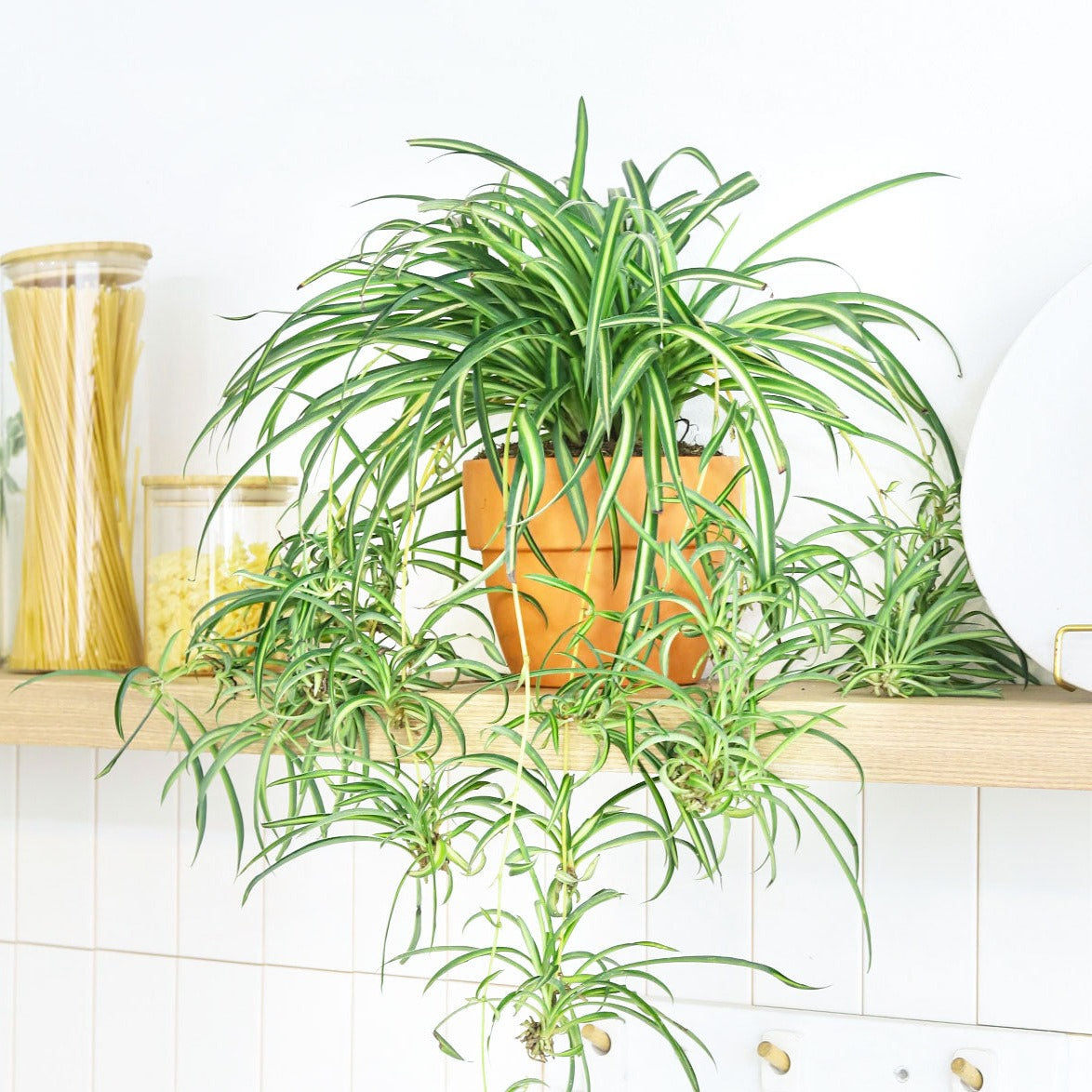
spider plant pot Spider PlantDescription Light Soil Water Hardiness Spider Plant, or Chlorophytum comosum, is one of the most adaptable houseplants and can grow in almost any indoor environment. This evergreen perennial plant is a member of the Asparagaceae family. It has a very distinctive look with tiny offsets hanging from the parent plant, looking like spiders on a web. Chlorophytum comosum has long, thin green leaves with creamy yellow edges that can reach around 12 inches

  • Spider Plant, or Chlorophytum comosum, is one of the most adaptable houseplants and can grow in almost any indoor environment. This evergreen perennial plant is a member of the Asparagaceae family. It has a very distinctive look with tiny offsets hanging from the parent plant, looking like spiders on a web.

    Chlorophytum comosum has long, thin green leaves with creamy yellow edges that can reach around 12 inches in length. This plant is especially suitable for hanging baskets and tall planters.

    Spider plant is very effective in cleaning indoor air by absorbing common toxins like formaldehyde, xylene, benzene, and carbon monoxide. This plant is also resilient, making it a perfect plant for any home and office.

    A mature Spider Plant occasionally produces dainty white flowers that have 3 to 6 petals. These flowers are unscented and very short-lived.

    ***No hook included.

  • Spider Plant thrives in bright to medium indirect sunlight, but it also tolerates lower light conditions. Too little light, however, can slow down its growth. Avoid hash direct sunlight.

    Spider Plant should be watered about once per week. It prefers slightly moist but not waterlogged soil. Water thoroughly and drain well after each watering.

    Spider Plant loves moist but well-drained soil. It prefers a soil mix with a slightly acidic (pH 6.0-7.0).

    This plant grows best in normal room temperatures (between 65°F-85°F)and does not like temperatures below 50°F. Spider Plant tolerates a wide range of humidity from 40-80%, making it an easy houseplant for any living space.

    This plant should be fertilized once or twice during the growing season (spring/summer) with diluted houseplant fertilizer.

  • USDA Zone 9-12

    USDA Zone 9b: to -3.8 °C (25 °F)

    USDA Zone 10a: to -1.1 °C (30 °F)

    USDA Zone 10b: to 1.7 °C (35 °F)

    USDA Zone 11: above 4.5 °C (40 °F)

Shipping Notes
  • Free Standard Shipping on $100+ Orders to the USA.
  • Except Preorder products are shipped in 48 hours.
  • Delivery to the USA:
  1. Standard Shipping : 3-10 business days
  • If time is of the essence, please consider selecting expedited delivery for faster service.
Exchange/Return Notes
  • We offer a 30-day return/exchange service after receiving.
  • Final sale items are not eligible for returns or exchanges.
  • To process your return/exchange, please contact us at [email protected]
  • Please click here for more details>>> Return & Exchange Policy
SKU: 28667532688

Discover Niche Categories That Outsell spider plant pot

Top-Converting Item to Boost Your Average Order

4.6 ★★★★★
Based on 17 reviews
Sort
Highest Rating
Newest First
Oldest First
Product Reviews
A
Verified Purchase
Amazon customer Colleen T
Alexandria, US
★★★★★ 4
Very short and very good
Format: eTextbook
I read this book or one similar to it my senior year in high school 1970. It absolutely caught my attention as a way to explain why the continents had separated from Gondwanaland. I really liked revisiting the theory in light of the advances made since then
WAS THIS REVIEW HELPFUL?YesReportShare
Reviewed in the United States on May 8, 2018
D
Verified Purchase
Dr L
Fort Morgan, US
★★★★★ 5
I love VSI on Kindle
Format: eTextbook
The thing is they take a long time to read because of the look up feature. It's like reading a book in the Library of Congress.
WAS THIS REVIEW HELPFUL?YesReportShare
Reviewed in the United States on June 15, 2020
A
Verified Purchase
Amazon Customer
Bozeman, US
★★★★★ 5
There are few who are capable of telling the story ...
Format: Paperback
There are few who are capable of telling the story of plate techtonics including critical details. Peter Molnar is one of those chosen few who can deliver such a story succinctly and precisely.
WAS THIS REVIEW HELPFUL?YesReportShare
Reviewed in the United States on February 12, 2017
J
Verified Purchase
JustLiberty
Bozeman, US
★★★★★ 5
Very nice, but very short, book on the subject.
Format: Paperback
This is a very nice, but very short, book on the subject. I learned quite a bit and enough to delve into structural geology and related subjects.
WAS THIS REVIEW HELPFUL?YesReportShare
Reviewed in the United States on August 22, 2015
B
Bayard B.
Houston, US
★★★★★ 4
Excellent 120 pages book on a complex subject.
Format: Paperback
I thought this was an excellent 120 pages book on a complex subject. It discusses a variety of subjects besides the title of plate tectonics and which are related to it: continental drift, oceanic seafloor spreading, fracture zones, subduction of tectonic plate edges, faulting, the creation of mountains and plateaus, earthquakes, volcanism, oceanic magnetic anomalies, and the locations of concentrated metallic ores. The text is accompanied by almost 40 sketches and diagrams elaborating on the discussions provided in the text. The book also introduces the grand concepts of Earth geology such as the mantle, lithosphere, and asthenosphere. It also provides a short history of the development of the concept of plate tectonics. Finally, the book provides specific detailed descriptions of the formation of major mountain ranges and plateaus such as the Himalayas, the Tibetan Plateau, Tien Shan, the Tarim Basin, the movement of Eastern Asia, the Andes, and the western US mountain ranges. It also gives a short description of the movement of India from the eastern edge of the African Plate to the Eurasian Plate over the past 90+ million years.
WAS THIS REVIEW HELPFUL?YesReportShare
Reviewed in the United States on February 14, 2023

recommand products