SKU: 32009985537
marble queen pothos humidity

marble queen pothos humidity Epipremnum 'Marble Queen'

Sale price$18.31 Regular price$20.34
Save 10%

Pay in installments of $5.08 with ShopPay, AfterPay and Klarna

Shipping Estimate
USA
  • USA
  • CAN

Ships within 48 hours · Estimated delivery Sep 25 - Sep 30

Promo Codes Available:

For Your Every Summer RSVP, with Code: SUMMER15

Description

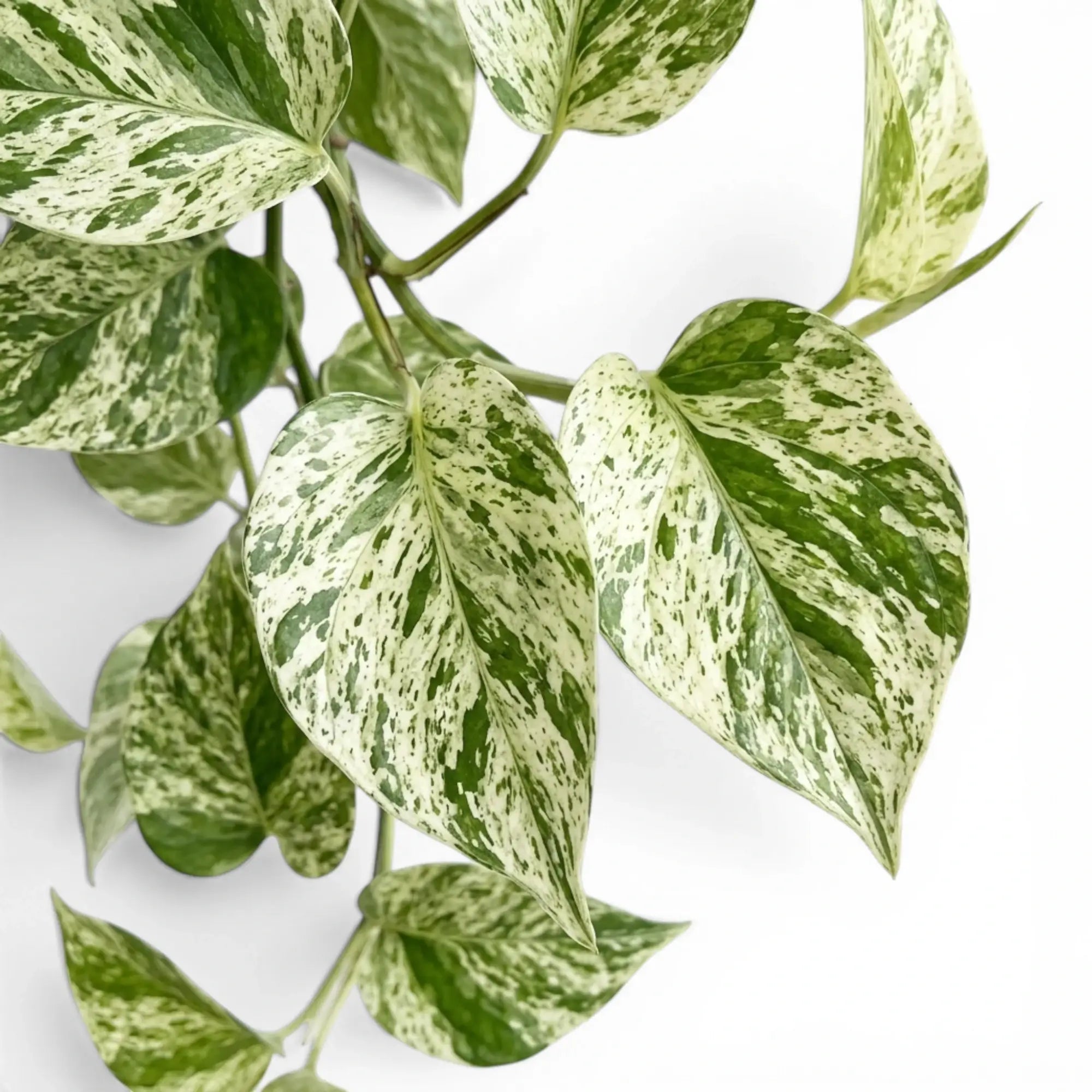
marble queen pothos humidity Epipremnum 'Marble Queen'Epipremnum aureum 'Marble Queen' Epipremnum aureum 'Marble Queen' is a variegated pothos with glossy heart shaped leaves washed, flecked, and streaked in cream white and green. Each leaf carries its own balance of pale and green tissue, giving the vine a light, marbled appearance while keeping the node based vining growth of Epipremnum aureum. The plant grows from long stems with nodes and aerial roots. In a pot it can trail over the rim, climb a

Epipremnum aureum 'Marble Queen'

Epipremnum aureum 'Marble Queen' is a variegated pothos with glossy heart-shaped leaves washed, flecked, and streaked in cream-white and green. Each leaf carries its own balance of pale and green tissue, giving the vine a light, marbled appearance while keeping the node-based vining growth of Epipremnum aureum.

The plant grows from long stems with nodes and aerial roots. In a pot it can trail over the rim, climb a support, or be pruned into a fuller shape. Because many leaves carry a high proportion of pale tissue, 'Marble Queen' usually grows at a measured pace and needs bright indirect light, airy substrate, and consistent warmth.

As a selection of Epipremnum aureum, it belongs to a wet-tropical climbing species from Mo‘orea in the Society Islands, where aerial roots help the stems attach and climb through humid forest.

Pale marbling and vine habits

  • Cream-white and green marbling across glossy juvenile leaves.
  • Flexible vines that can hang, climb, or be cut back for denser growth.
  • Aerial roots at the nodes for support attachment and easy propagation.
  • Light-coloured foliage needs bright indirect light that avoids scorch.
  • Node-based stems with aerial roots for trailing, climbing and propagation.

How the marbled leaves develop indoors

'Marble Queen' has pale marbling across green leaf tissue, and the green sections remain important for growth. Leaves with very large cream sections can age or mark sooner when exposed to strong sun, dry heat, or salt build-up. With healthy roots and soft bright light, new leaves expand cleanly and pale sections mark less easily.

Like the species, this cultivar stays juvenile indoors under normal pot culture. Leaves remain heart-shaped and comparatively modest in size unless the plant receives long-term support, warmth, and climbing conditions. Regular pruning keeps long vines from becoming bare and allows rooted cuttings to be placed back into the pot for a fuller plant.

Care for cream-white pothos foliage

  • Light: Give bright indirect light. Soft bright light reduces stretching while avoiding scorch on the pale parts of the leaf.
  • Water: Water when the upper 25–35% of the mix has dried. Check deeper in the pot before watering, as pale variegated vines can use water more slowly.
  • Substrate: Use a chunky aroid mix with bark, perlite, coco chips, or pumice. Dense wet soil increases the risk of root decline.
  • Temperature: Keep between 18–27 °C. Warm, stable conditions help the plant maintain root activity and new leaf production.
  • Humidity: Moderate indoor humidity is acceptable. Higher humidity helps new leaves unfurl with fewer dry marks, especially on long vines.
  • Feeding: Feed lightly in spring and summer. Avoid heavy fertiliser doses, which can leave salt residue around the roots and mark pale leaf edges.
  • Pruning: Cut stretched or mostly green stems above a node. Root the cuttings to thicken the plant or renew older vines.

Stress marks on pale leaves

  • Brown tips on cream areas: Check sun exposure, dry heat, salt build-up, and irregular watering. Pale tissue usually shows stress first.
  • New leaves with less marbling: Review light levels and prune greener stems if they begin to dominate the pot.
  • Yellow leaves with wet mix: Let the root zone dry further before watering and check whether the potting mix drains freely.
  • Small leaves on long vines: Add more bright indirect light or provide support so the stems can grow with better structure.
  • Spotted or distorted new leaves: Inspect the newest growth for thrips, mites, or mechanical damage while the leaves are still rolled.

Safety for pets, children, and pruning

Epipremnum aureum 'Marble Queen' contains insoluble calcium oxalate crystals. Chewed foliage can cause irritation, and cut stems may bother sensitive skin, so place the plant thoughtfully and wash hands after pruning.

Meaning of the botanical name

Epipremnum refers to the climbing habit of the genus, from Greek roots meaning “upon” and “trunk.” Aureum means “golden.”

Shipping Notes
  • Free Standard Shipping on $100+ Orders to the USA.
  • Except Preorder products are shipped in 48 hours.
  • Delivery to the USA:
  1. Standard Shipping : 3-10 business days
  • If time is of the essence, please consider selecting expedited delivery for faster service.
Exchange/Return Notes
  • We offer a 30-day return/exchange service after receiving.
  • Final sale items are not eligible for returns or exchanges.
  • To process your return/exchange, please contact us at [email protected]
  • Please click here for more details>>> Return & Exchange Policy
SKU: 32009985537

Discover Niche Categories That Outsell marble queen pothos humidity

Top-Converting Item to Boost Your Average Order

4.3 ★★★★★
Based on 21 reviews
Sort
Highest Rating
Newest First
Oldest First
Product Reviews
A
AnnieB
West Palm Beach, US
★★★★★ 5
Sensitively written and beautifully illustrated
Format: Hardcover
Why Do We Cry? is an sweetly illustrated and sensitively written book for young readers. Originally published in Spanish in 2018, this English translation released 7th April 2020 from Kids Can Press is 34 pages and available in hardcover and ebook formats. The book takes the form of a dialogue between a mother and son about why people cry and why it's good to examine and experience negative emotions so we can process them and what function tears (and crying) actually serve physiologically and emotionally. The text by Fran Pintadera (weblink in Spanish) is supported and enhanced beautifully by the nuanced illustrations by Ana Sender. This would make a superlative reading circle, library group, or classroom read for youngsters. There's a short discussion resource at the back of the book which includes some science based information on tears and the physiological functions they perform. Learning to process strong emotion in a positive and constructive manner is -vital- for development. I appreciated that the dialogue was sensitively handled and that the author chose to make the child male was a nice touch. I think that this could be a very valuable book *especially* given our current pandemic world situation. Five stars. Beautiful little book with universal relevance. Disclosure: I received an ARC at no cost from the author/publisher for review purposes.
WAS THIS REVIEW HELPFUL?YesReportShare
Reviewed in the United States on April 19, 2020
L
Linsey
Waukegan, US
★★★★★ 5
A thoughtful book to normalize tears
Format: Hardcover
I'm a child life specialist I have heard many parents and providers tell kids (and teens) to "stop crying" or "there's nothing to cry about" or some other variation of that hurtful phrase. I now work with children who have a parent with a serious illness and those experiencing grief. Why Do We Cry? is an amazing resource that is relevant to the majority of situations experienced by kids in my practice. It is beautifully illustrated with images that reflect the emotion in the written content. This book embraces the many reasons people cry without overstepping a boundary by trying to explain or justify the feelings. I love the subtlety of normalizing a variety of feelings and the gentle truth that sometimes we cry without knowing why. I highly recommend this book!
WAS THIS REVIEW HELPFUL?YesReportShare
Reviewed in the United States on December 10, 2022
J
Jessica Page
Draper, US
★★★★★ 5
5 Stars!
Format: Hardcover
Mario asks his mother, “Why do we cry?” and she goes on to tell him all the different reasons that we do cry. Some of the reasons are a bit metaphorical, and might be harder for younger children to understand, but the illustrations help in those cases. (The book is aimed for 3-7 year olds, but I think the story is more fitting for ages 5 and up). The illustrations correspond well with the words on the page. The story lets children know that it is ultimately ok to cry. I feel that the book showcasing a boy asking about crying is wonderful as some boys are told NOT to cry. A few added pluses: There is also a lesson that scientifically explains about tears so children can understand some of the varying reasons that tears exist. There is also a small interactive section with activities dealing with tears that will help children express their imagination. Many thanks to Kids Can Press for granting me an e-arc to read that I chose to review. A+ on this children’s picture book!
WAS THIS REVIEW HELPFUL?YesReportShare
Reviewed in the United States on April 7, 2020
S
Stacy Renee
Belleville, US
★★★★★ 4
Learn why we cry in this great kids book!
Format: Hardcover, Format: Hardcover
I received a digital copy of this book from the publisher. All thoughts and opinions are my own. "Some days we cry because we call out for a hug but all we get back is an echo." Why Do We Cry? begins with a boy asking his mother why we cry. There are many answers to such a question and the mother helps the boy explore the many reasons why we may shed tears. As the mother explains the reasons why we cry, the illustrations become a bit surreal, to show the emotions and feelings associated with crying, from sadness to anger to grief. The mother compares and contrasts, all the while weaving a poetic story about her own life or memories and emotions. This book reminds us that it is okay to cry, that crying can be a release, a way to heal, or let go. It helps us understand the difference between emotions and how they affect us. There's an educational spread at the end of the book that teaches us the different types of tears, one of which--emotional tears-- is featured in this book, what they are made of, and even how much they weigh!
WAS THIS REVIEW HELPFUL?YesReportShare
Reviewed in the United States on June 12, 2020
C
'chelle
Birmingham, US
★★★★★ 5
A Beautiful & Informative Exploration of Tears and Feelings
Format: Hardcover
A nonjudgemental and supportive exploration of the reasons we cry accompanied by imaginative and thoughtful art. Beautiful and informative, the final two pages include scientific information on tears to complement the emotional context of the main part of the story. Suitable for ages 3 to 7.
WAS THIS REVIEW HELPFUL?YesReportShare
Reviewed in the United States on August 25, 2020

recommand products