Pay in installments of $6.39 with
 ,
,
 and
and

Shipping Estimate
USA
- USA
- CAN
- USA
- CAN
Ships within 48 hours · Estimated delivery Sep 25 - Sep 30
 Promo Codes Available:
For Your Every Summer RSVP, with Code: SUMMER15
Description
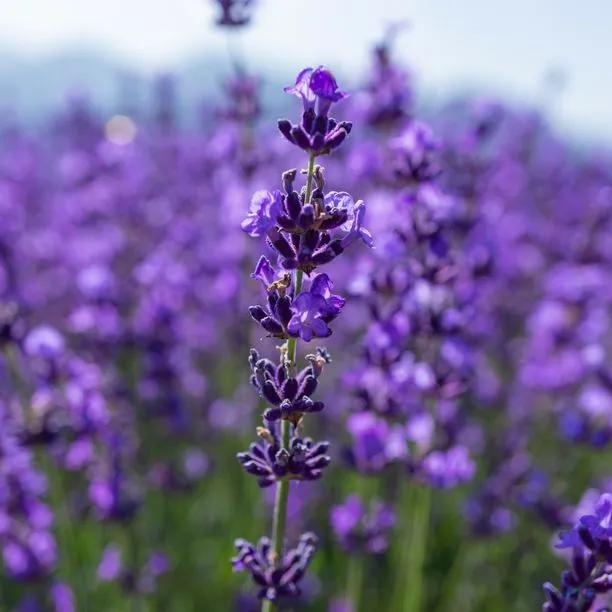
darkest lavender flower Hidcote Lavender – Deep Purple English Lavender AGMVariety: Hidcote Species: Lavandula angustifolia (English lavender) Colour: Deep purple blue the darkest of the classic English lavenders Foliage: Evergreen, aromatic, narrow silver grey leaves Height: 4560cm (1824in) Spread: 4575cm Flowering: July to August, roughly two weeks after Munstead Scent: Strong, classic English lavender. Probably best for drying and bags Hardiness: Fully hardy throughout the UK RHS AGM: Yes first awarded 1932, reconfirmed
- Variety: Hidcote
- Species: Lavandula angustifolia (English lavender)
- Colour: Deep purple-blue — the darkest of the classic English lavenders
- Foliage: Evergreen, aromatic, narrow silver-grey leaves
- Height: 45–60cm (18–24in)
- Spread: 45–75cm
- Flowering: July to August, roughly two weeks after Munstead
- Scent: Strong, classic English lavender. Probably best for drying and bags
- Hardiness: Fully hardy throughout the UK
- RHS AGM: Yes — first awarded 1932, reconfirmed 2002
- Introduced: Selected at Hidcote Manor Garden, Gloucestershire, by Major Lawrence Johnston
- Sold as: Pot-grown plants (P9, 2L and 5L available depending on season)
- Plant outdoors: From late April onwards when soil is warming. May is safer in the North
- Delivered: From April/May, weather dependent
Hidcote Lavender — The One Everyone Knows
There is a reason Hidcote is the bestselling lavender in the country. The colour is deeper and richer than any other English lavender, a true imperial purple-blue that you notice from the other side of your garden. The flower spikes are taller and more upright than Munstead's, giving a hedge or border that characteristic look — a low wall of silver foliage with purple spears standing to attention above it. The scent is strong, the bees love it, and the flowers dry beautifully for bags and bunches. If you have never grown lavender before but want the one you've seen in photographs of English gardens, this is it.
Hidcote flowers a couple of weeks later than Munstead, which is worth knowing if you're planting both — you get a longer season using them together, the paler blue opening first and the darker purple following on. It is fully hardy in the UK and will put up with (actually prefers) poor soil and handles exposed sites and coastal winds without complaint. Left unpruned it will eventually look like a bad centre parting, as all lavenders can, but an annual trim after flowering keeps it tight for years. (My eldest half-sister who was a great gardener bought her Hidcote from Ashridge in 2004 and it was still going strong and looking good when she died more than 10 years later - Ed.) The RHS has given it an Award of Garden Merit twice — in 1932 and again in 2002 — which says something about a plant that has been around for the best part of a century and still more than holds its own against all the newer introductions.
The American Who Made English Gardens
Hidcote takes its name from Hidcote Manor Garden, near Chipping Campden in the Gloucestershire Cotswolds. The garden was created from bare fields starting in 1907 by Major Lawrence Johnston; one of the more unlikely figures in English horticulture. Born in Paris in 1871 to a wealthy American family, educated at Trinity College Cambridge, he became a naturalised British citizen, fought in the Boer War and both World Wars, and also spent forty years turning a windswept hilltop into what is now one of the most visited gardens in England. Johnston was a passionate plant collector who sponsored expeditions to China and South America, but his real genius was in design: the garden at Hidcote is laid out as a series of "rooms" divided by hedges, each one with a different character. It was the first garden-only property the National Trust accepted, in 1948, and the "outdoor room" idea that Johnston pioneered is now so widely used that we forget someone had to invent it.
The lavender that carries the Hidcote name was one of Johnston's own selections from the garden — chosen for the depth of its colour and the compactness of its habit. It was awarded its first RHS AGM in 1932, when garden lavenders were far less numerous than they are now. Nearly a century later, with dozens of newer cultivars to compete against, it is still great.
Planting Companions
Hidcote's deep purple is strong enough to anchor almost any planting combination. For a two-tone lavender hedge, alternate it with Rosea — the pale pink against the dark purple is a classic. Plant it in front of Grosso for a stepped effect, with the taller Dutch lavender's longer spikes rising behind. For a white-and-purple combination in a contemporary border, pair it with Edelweiss. Beyond lavender, Hidcote sits beautifully with rosemary, with catmint tumbling at its feet, with old roses above it, or with nothing at all — a simple line of Hidcote along a warm stone path is hard to improve on.
Why Use Ashridge?
Your Hidcote lavender is grown here and sent to you when planting conditions are right. We deliver by next-day courier, and your plants come with our guarantee and friendly advice if you need it from real people in Somerset. Have a look at our full English lavender collection or browse all our lavender plants. We also hold a Feefo Platinum Service Award — which means a lot of our customers are happy.
Frequently Asked Questions
What is the best lavender for hedging in the UK?
On balance, probably Hidcote. It has the strongest colour contrast, holds its shape well with annual pruning, and is completely hardy. Planted at three per metre (33cm apart) you will have a solid hedge by the end of the first summer if you start with 2L pots, or by the second summer with P9s. More detail in our lavender growing guide.
Is Havana lavender better than Hidcote?
They are very similar. Havana is a newer Dutch-bred variety that has flowers of the same colour, at the same time, to about the same height. Some growers say its winter foliage stays neater. Both have the RHS AGM. Havana is fractionally more compact but here on the nursery we think Hidcote's summer foliage has the edge.
Can I grow Hidcote lavender in a pot?
Of course - all lavender does well in containers. Use a pot at least 30cm across with good drainage holes and a gritty, loam-based compost. Don't overfeed it — lavender flowers better when it's hungry. Full advice in our lavender growing guide.
How long does Hidcote lavender last?
A well-pruned Hidcote will look good for eight to ten years, sometimes longer on very free-draining soil. After that, plants tend to get woody and thin at the base. However when replacement time comes you can simply plant new plants where your old ones were - no worries about replant disease.
Does Hidcote lavender need full sun?
It needs as much sun as you can give it. A south-facing or west-facing position is ideal. In anything less than about six hours of direct sun, the flowers will be fewer, the colour less intense, and the plant more inclined to splay open. If your only available spot is partly shaded, you will get a plant that survives but never quite looks the way you hoped.
When should I prune Hidcote lavender?
A light shape in early spring — late February to March — then a proper trim after flowering in late August or September. Our lavender pruning guide has the detail.
Shipping Notes
- Free Standard Shipping on $100+ Orders to the USA.
- Except Preorder products are shipped in 48 hours.
- Delivery to the USA:
- Standard Shipping : 3-10 business days
- If time is of the essence, please consider selecting expedited delivery for faster service.
Exchange/Return Notes
- We offer a 30-day return/exchange service after receiving.
- Final sale items are not eligible for returns or exchanges.
- To process your return/exchange, please contact us at [email protected]
- Please click here for more details>>> Return & Exchange Policy