SKU: 42041869849
prince of orange hybrid philodendron

prince of orange hybrid philodendron Philodendron 'Prince of Orange'

Sale price$25.52 Regular price$28.35
Save 10%

Pay in installments of $7.09 with ShopPay, AfterPay and Klarna

Shipping Estimate
USA
  • USA
  • CAN

Ships within 48 hours · Estimated delivery Jul 23 - Jul 28

Promo Codes Available:

For Your Every Summer RSVP, with Code: SUMMER15

Description

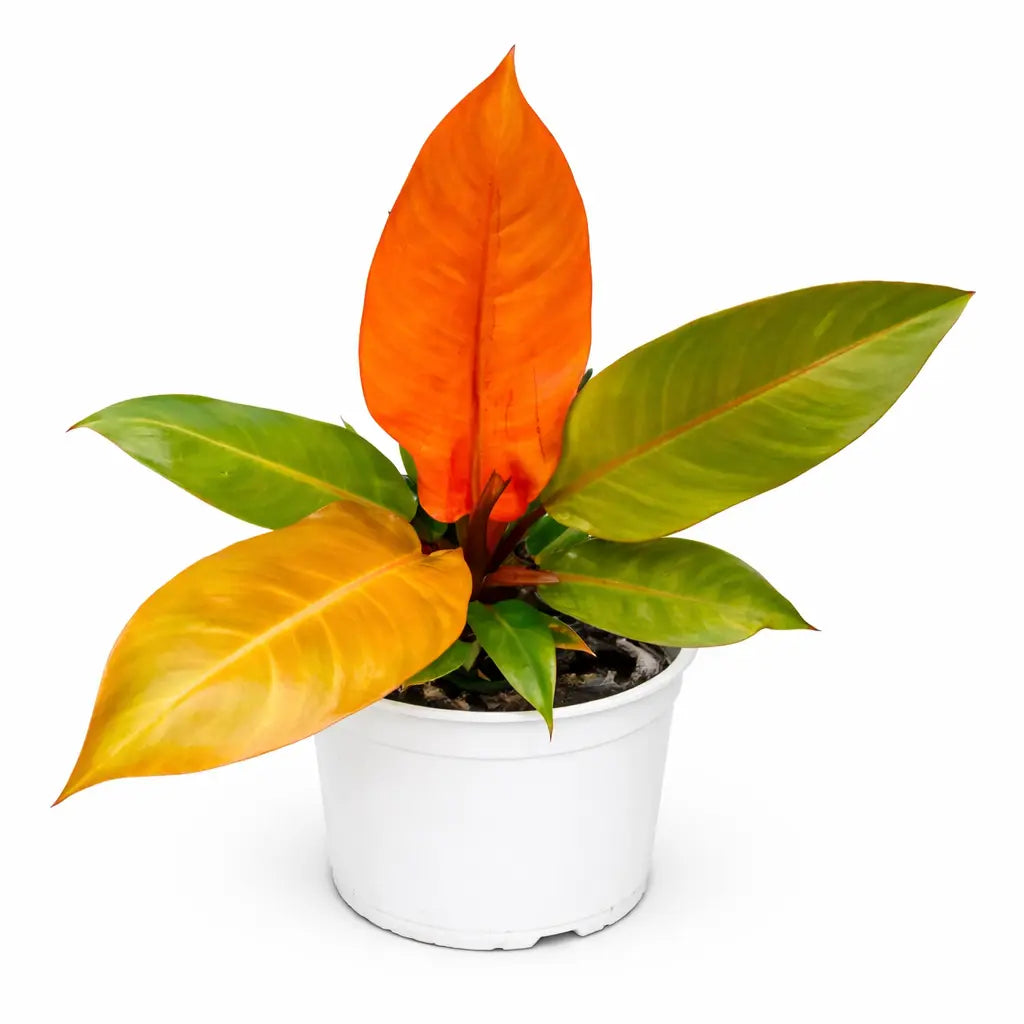
prince of orange hybrid philodendron Philodendron 'Prince of Orange'The Philodendron 'Prince of Orange' is one of those rare plants that earns its name without any exaggeration. Every new leaf that unfurls does so in vivid orange deep, saturated, genuinely the colour of a ripe citrus then spends the following weeks travelling through copper and amber and chartreuse before settling into the rich, glossy dark green of a mature leaf. Because the plant pushes new growth continuously, multiple stages of this journey are

The Philodendron 'Prince of Orange' is one of those rare plants that earns its name without any exaggeration. Every new leaf that unfurls does so in vivid orange — deep, saturated, genuinely the colour of a ripe citrus — then spends the following weeks travelling through copper and amber and chartreuse before settling into the rich, glossy dark green of a mature leaf. Because the plant pushes new growth continuously, multiple stages of this journey are always visible simultaneously: a fully orange new spear at the centre, copper leaves mid-transition, and deep green mature leaves forming the outer canopy. No two moments in the growing season look quite the same. A hybrid of the *Philodendron erubescens* lineage — *erubescens* meaning "blushing" in Latin, a name suddenly made literal by the Prince of Orange's extraordinary leaf colour — it is entirely self-heading: it grows as a compact, symmetrical rosette without climbing, without needing a moss pole, and without taking over a room. At 60–90 cm at maturity it is perfectly scaled for desks, shelves, and tabletops, and it is one of the fastest-growing self-heading Philodendrons available.

💡 Stable Colour — This Is Not Variegation The orange colouration of the Prince of Orange is genetically locked into the plant's growth cycle — it is not chimeric variegation and it does not revert. Every new leaf this plant produces will emerge orange, without exception. The colour is driven by pigment expression in new growth that fades as chlorophyll develops and the leaf matures — a reliable, repeatable process. The intensity of the orange phase is directly controlled by light: brighter indirect light = more vivid, longer-lasting orange before the leaf greens up. Lower light = the orange phase is shorter and the leaf transitions to green faster. More light is the single most effective tool for keeping the display as vivid as possible.
🌿 Self-Heading Habit — No Pole, No Climbing, No Drama Unlike the majority of collector Philodendrons, the Prince of Orange does not climb and does not need support. It grows as a compact, upright rosette, producing new leaves from the central growing point and expanding outward symmetrically. This makes it one of the most practical collector aroids available — ideal for desks, console tables, windowsills, and shelves where a climbing vine would be out of place. Simply rotate the pot a quarter turn every few weeks to ensure even light exposure and a balanced, symmetrical form.
☀️

Light

Bright indirect light — the most important factor for a vivid, long-lasting orange display. An east or west-facing window is ideal; a south-facing window with a sheer curtain works well. The orange phase is most intense and lasts longest in bright conditions — in lower light the new leaves transition to green quickly and the distinctive colour display loses much of its impact. No direct harsh afternoon sun — it scorches and bleaches the leaves. Gentle morning sun is fine and beneficial. A grow light at 12–14 hours is excellent and produces the most consistently colourful new growth.

💧

Watering

Allow the top 3–5 cm to dry before watering thoroughly. The Prince of Orange prefers to dry out a little more between waterings than moisture-loving aroids — consistent soggy soil causes root rot faster in self-heading forms. Use room-temperature filtered water where possible. Empty the saucer after watering; never allow to sit in standing water. Reduce frequency slightly in winter but never allow to dry out completely. Check weekly; water when the top layer is clearly dry rather than just slightly dry.

💦

Humidity

50–70% preferred — a humidifier is beneficial but not essential. The Prince of Orange is more humidity-tolerant than many collector aroids and adapts well to typical Indian indoor conditions. Keep away from cold AC drafts and heating vents. Do not mist directly onto the leaves — water sitting on the new orange leaves encourages brown spotting, particularly on the tender young growth. India's tropical climate is naturally adequate for outdoor or semi-outdoor growing.

🌱

Growing Media

Well-draining aroid mix — 40% quality potting soil, 25% orchid bark, 25% perlite, 10% coco coir. pH 5.5–7.0. The mix must drain freely; self-heading Philodendrons are more susceptible to root rot from compacted, moisture-retentive mixes than climbing forms. Repot every 1–2 years in spring, one pot size up — the plant prefers to be slightly snug rather than over-potted. A pot with drainage holes is essential; terracotta is a good option for extra drainage insurance.

🌾

Feeding

Balanced liquid fertilizer at half strength every 2–3 weeks in spring and summer. The fast growth rate means consistent feeding during the growing season is visibly rewarded — larger leaves and more frequent new growth flushes. Apply to moist soil only. Flush every 3 months to prevent mineral salt build-up. Stop feeding in autumn and winter. Avoid high-nitrogen formulas — they push very fast leafy growth that outpaces the plant's structural development.

⚠️ Common Issues & Quick Fixes

New Leaves Coming Out Green, Not Orange

Insufficient light — the most common complaint. The orange phase shortens and fades dramatically in low light; in deep shade new leaves can emerge barely orange at all. Move to a significantly brighter indirect position or add a grow light. The colour will return to full intensity within 1–2 new growth cycles in better light. This is not reversion — the plant cannot revert; it is purely a light response.

Brown Spots on New Orange Leaves

Water contact on tender new leaves — do not mist; ensure watering does not splash onto unfurling leaves. Also check for thrips, which target new growth specifically: silver streaking or distorted unfurling leaves indicate thrips. Treat with spinosad spray every 5–7 days for 4 weeks and quarantine immediately.

Yellow Leaves

Overwatering or root rot — allow the top 3–5 cm to dry before watering. One older lower leaf yellowing as new growth pushes is normal cycling. Widespread yellowing with soggy soil: unpot, inspect roots, trim any blackened or mushy sections, repot in fresh well-draining mix, and water less going forward.

Leaves Staying Small

Insufficient light, underfeeding, or the plant being too root-bound to support larger leaf production. Move to a brighter position, begin consistent feeding every 2–3 weeks, and check whether the plant needs repotting — roots circling the base of the pot indicate it is ready for the next size up.

Leggy or Lopsided Growth

The plant is reaching toward its light source — rotate a quarter turn every 2–3 weeks to maintain even, symmetrical growth. If the plant has become significantly lopsided, increase overall light levels and begin regular rotation to gradually correct the form.

📋 Quick Plant Profile

Botanical Name Philodendron erubescens 'Prince of Orange'
Name Meaning erubescens = Latin for "blushing" — the vivid orange-red new leaf colour taken to its most dramatic expression
Common Names Prince of Orange, Orange Splendor (Indian market trade name)
Family Araceae
Colour Journey Vivid orange → copper → amber → chartreuse → deep glossy green; all stages visible simultaneously
Colour Type Stable genetic trait — not variegation; every new leaf will be orange; does not revert
Colour Key More light = longer, more vivid orange phase; less light = faster transition to green
Growth Habit Self-heading rosette — does not climb; no moss pole needed; compact and symmetrical
vs. erubescens Emerald Queen Same lineage; Emerald Queen is a climber with cream variegation; Prince of Orange is self-heading with orange new growth
Light Bright indirect; no direct harsh sun; grow light excellent; low light fades orange phase
Watering Top 3–5 cm dry between waterings; well-draining mix essential; do not sit in water
Humidity 50–70%; adaptable; no misting on leaves; humidifier beneficial but not essential
Temperature 18°C–30°C; no cold drafts; thrives in Indian indoor conditions
Mature Size 60–90 cm height and spread; compact; ideal for desks, shelves, and tabletops
Growth Rate Fast for a self-heading Philodendron — new leaves in frequent succession with good light and feeding
Rotation Quarter turn every 2–3 weeks for even, symmetrical growth
Ideal For Desks, Shelves, Tabletops, Bright Rooms, Collectors, Gifting, Beginners and Experts Alike
Care Level Easy to intermediate — bright light is the one non-negotiable; everything else is forgiving
Shipping Notes
  • Free Standard Shipping on $100+ Orders to the USA.
  • Except Preorder products are shipped in 48 hours.
  • Delivery to the USA:
  1. Standard Shipping : 3-10 business days
  • If time is of the essence, please consider selecting expedited delivery for faster service.
Exchange/Return Notes
  • We offer a 30-day return/exchange service after receiving.
  • Final sale items are not eligible for returns or exchanges.
  • To process your return/exchange, please contact us at [email protected]
  • Please click here for more details>>> Return & Exchange Policy
SKU: 42041869849

Discover Niche Categories That Outsell prince of orange hybrid philodendron

Top-Converting Item to Boost Your Average Order

4.8 ★★★★★
Based on 12 reviews
Sort
Highest Rating
Newest First
Oldest First
Product Reviews
M
Verified Purchase
Miriam Velez
West Palm Beach, US
★★★★★ 4
Good quality, but my dog didn’t like it
Size: 24"X24"
The product arrived in perfect condition and looks well made. It’s sturdy and easy to clean, so I can see it working well for many dogs. However, my Cavapoo (17 lbs, 1 year old) never liked it. I tried for several weeks, but there was no way to get him to use it. I think it depends on the dog’s preference. For us, it didn’t work, but the product itself is good quality.
WAS THIS REVIEW HELPFUL?YesReportShare
Reviewed in the United States on August 20, 2025
K
Verified Purchase
Kindle Customer
Fort Morgan, US
★★★★★ 5
Excellent pee pad tray has "legs" to keep feet off of the pad
Size: 18"X24", Size: 18"X24"
My 10 week old Pekingese learned quickly to use it, and Pekingese are a very stubborn breed. We started training her by removing the grid because she was used to paper. It snaps out easily. We used pee pads with sticky tabs to attach the pad, then snapped the "frame" in place without the grid. Within a few days, she had figured it out, so we snapped the grid back in so her feet never touch the used pad. No more wet feet. I bought the medium size that is aqua blue. For those that ask if it will fit their crate...measure your crate! My large crate is 42" x 23" and the tray fits two ways as seen in the pictures. My small crate is 23" x17" and the tray does NOT fit. I wish the company made a 10" x 14" tray for traveling. (pink???) Start using it when you have a couple of days to give your puppy 100% of your attention. 100% attention!! If she/he does not use it, then it is your fault for not paying attention. My puppy would go every 15 minutes at first! Put a WHITE plastic shower curtain liner on your floor so you can see if she misses it. The liner wipes off easily with Clorox wipes or goes in the washing machine. For those puppies who stand on the edge of the tray, but still miss it because their back legs are barely on it, help them walk forward and put plastic under the tray to catch any misses. Now, at 4 months old, she seldom uses it, but it is available. Her pen is getting larger and larger. After she pees outside, we let her run around in in the living room for about an hour, then she goes back in the pen. Her attention span is short and she can't always make it back to her tray in the pen. My husband always brings her in the house after she has peed one time outside, but if I take her outside, I wait until she goes at least 3 times and there won't be accidents in the house. Sometimes, it takes more than 1 time to empty their bladder. This pad tray is not like others on the market. Look closely at other grids, and you will see that other trays do not have the "legs" on the under side of the grid that keep the plastic grid from touching the used pad. My puppy tried to chew on the plastic tray, but she is always in our vision so we just say, "Ahhh!" and she leaves it alone. No problems with chewing. The Ahhh!" stops her every time, and we say it to stop her from doing anything wrong. Some people say their dog chews on it. Just like children, dogs need to be taught. Don't complain about how the pee pad or pee tray doesn't work. Teach your dog or your dog to not chew on it. Like others have mentioned, my puppy likes sleeping on the tray at night, because it has air circulating under it, so it is cooler than her bed. (Not the fault of the product!) We can't break her of that habit without confusing her or removing the tray. She may stop using it if we teach her to get her off it. I have been putting frozen gel compresses wrapped in a towel in her play pen during the day, and as long as the compress stays cold, she will lay on it instead of the pad tray. Always watch, so a dog doesn't chew on the gel compresses. I don't know why some people have said that urine runs out, because it is sealed. Maybe they are not changing the pads often enough. I started out changing them twice a day, then since my puppy started flea and tick medicine, she could start going outside. I changed the pad once a day then. Now, at 4 months old, she goes outside, but we put it in her large kennel at night. (The tray is too big to fit in her small dog kennel.) For the last three days and nights, she has not used it at all, but it is there just in case. If your tray does not have rubber pads on the bottom, buy some or put the tray on a piece of rubber kitchen shelf liner. My tray doesn't slide. If your dog runs to it and jumps on quickly, it may slide, so put something under it. Remember, your dog may not want to walk on it, but it is up to you to teach the dog to walk on it. They don't get a choice! You are in charge!
WAS THIS REVIEW HELPFUL?YesReportShare
Reviewed in the United States on September 17, 2020
A
Verified Purchase
Alejandra S Moreno
Draper, US
★★★★★ 5
Hands down, best pee pad holder
Size: 18"X24"
I did so much research to find the right puppy pad holder. I would give this 10 stars if I could. It’s softer plastic but not flimsy. The holes are comfortable for puppy feet. I see a lot with metal grates and pictures of injured doggy feet. Our pups are small and they walk on it just fine. I used to go through 10 pee pads a day. Now one pad lasts all day. Pups can’t go wee wee and trail it all over the house. Since it’s the same pee pad, pups look for the smell and are motivated to pee pee in the same spot. Puppies used to wake up several times a night because they would pee, step in it, tear up the pee pad, make a mess. The night time drama has definitely decreased significantly. Easy to lock, puppies can’t get into it. Easy to open to change out the pee pad. Comfortable to clean in a larger kitchen sink. Lightweight. Sometimes the doodie will go through the grates and sometimes it sits right on top, depending on the size of the doodie. Cleaning doodie stuck in the grate is never fun, but I use an old toothbrush and it works just fine. Very happy with this item.
WAS THIS REVIEW HELPFUL?YesReportShare
Reviewed in the United States on January 29, 2026
L
Verified Purchase
L
Natrona Heights, US
★★★★★ 1
easily destructed by puppy that chews
Size: 24"X24"
disappointed in this purchase. It comes in 2 pieces, which are not exactly easy to fit together and cumbersome. This design flaw also makes it very easy for puppies who are prone to chewing to destroy. It last 1 day then i had to toss it
WAS THIS REVIEW HELPFUL?YesReportShare
Reviewed in the United States on January 29, 2026
A
Verified Purchase
Amazon Customer
Chelsea, US
★★★★★ 3
Great, for the most part
Size: 24"X24"
Love it overall and super glad I chose this one after looking at so many. Pros: - Perfect size for what I needed. Fits exactly in the space it was planned for - Fits 22x22 pee pads nicely (which are easily accessible and cheaper than other sizes) - the color is a brighter blie than I was expecting and shinier in person, which I like very much :) Con: I didn't realize that it's actually 4 pieces. 2 for the top, 2 for the bottom, and you have to put them together. - I like the little weight distribution pieces they have so it keeps the top from sinking down onto the pee pad. A few problems with that: - I'm pretty great at putting together furniture, but for some reason one level connected fine and the other just would not go. I ended up using a flat head screwdriver to pry a piece out so it would go over the other. (If you buy it, you might understand what I mean better lol) - with it coming in 4 pieces instead of two, it's less structurally sound and tends to bow in the middle. Even more so because they put both middles parallel instead if perpendicular. - there are potty pads in there, but the seams create a more likely scenario of dripping onto my floor. Where I wouldn't have to worry about that with a solid piece. - I may have to take the whole thing apart to clean between the individual pieces and this may cause it to be less secure over time due to taking apart and putting back together over time. Great little thing overall and glad I got it :) serves it's purpose
WAS THIS REVIEW HELPFUL?YesReportShare
Reviewed in the United States on February 7, 2025

recommand products