Pay in installments of $6.07 with
 ,
,
 and
and

Shipping Estimate
USA
- USA
- CAN
- USA
- CAN
Ships within 48 hours · Estimated delivery Aug 29 - Sep 3
 Promo Codes Available:
For Your Every Summer RSVP, with Code: SUMMER15
Description
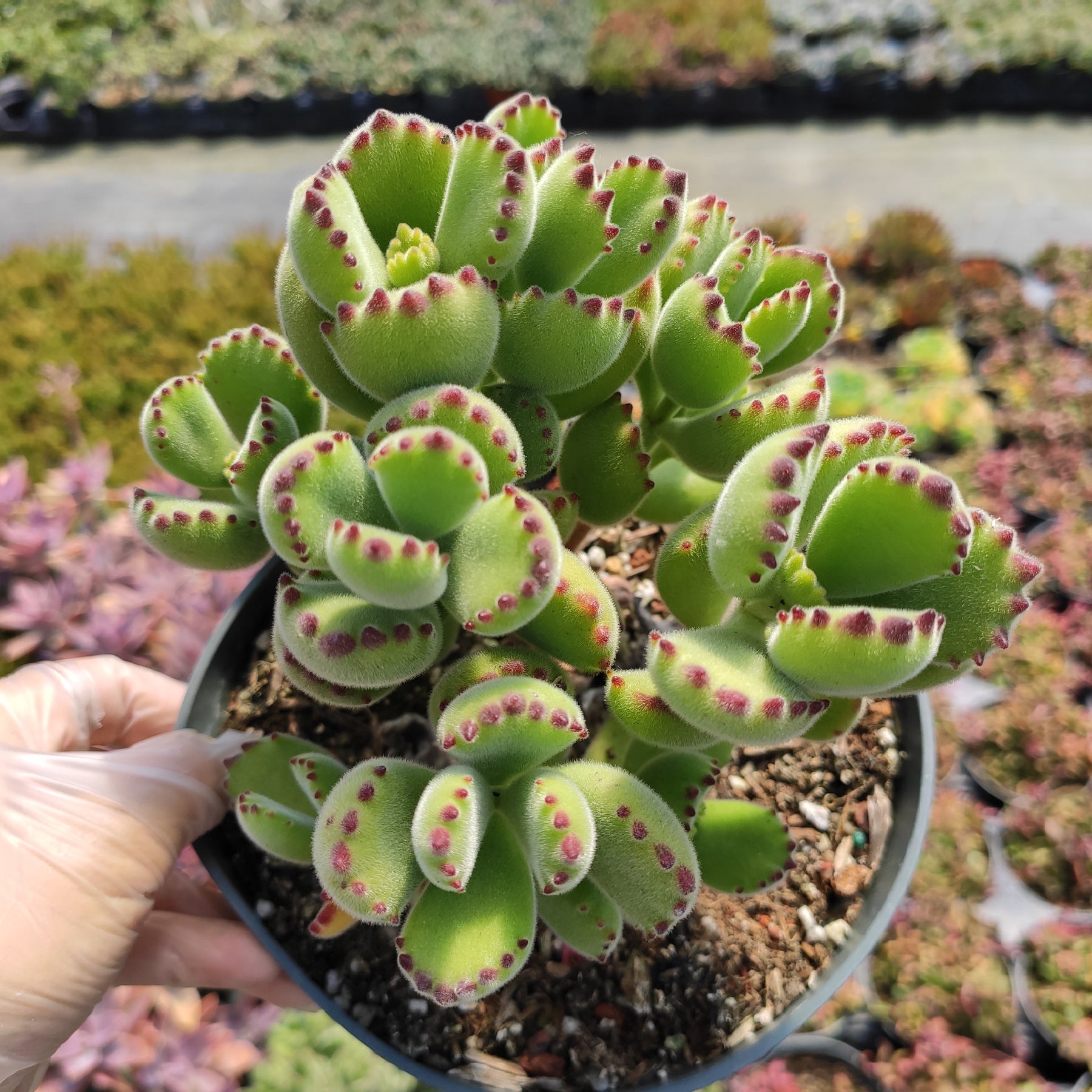
bear's claw succulent Cotyledon tomentosa Bear's PawCotyledon tomentosa Bears Paw is a perennial succulent plant in the family of Crassulaceae. The plant is much branched, with green stems, fertile fleshy leaves, decussate, ovoid, green, and densely white short hairs. The leaves have red claw like teeth at the tips, dichotomous cymes, yellow florets, and flowers from July to September. This species is native to the Cape Province of South Africa. It prefers a warm, dry, sunny and well ventilated
Cotyledon tomentosa Bear’s Paw is a perennial succulent plant in the family of Crassulaceae. The plant is much branched, with green stems, fertile fleshy leaves, decussate, ovoid, green, and densely white short hairs. The leaves have red claw-like teeth at the tips, dichotomous cymes, yellow florets, and flowers from July to September.
This species is native to the Cape Province of South Africa. It prefers a warm, dry, sunny and well-ventilated environment. Too high temperatures in summer will make it dormant. Avoid cold and excessive humidity. Propagation methods include cuttings. This species has beautiful leaf shape and color, delicate and small flowers, and leaves resembling the paws of a bear, which is a peculiar form and very cute, with high ornamental value.
The leaf blade of the bear child is fleshy, spatulate, densely white tomentose, the lower part of the entire margin, the leaf tip with brown teeth, like a small Bear’s Paw, very cute. It’s elegant, unique and beautiful, and can be used as a small indoor potted plant.
Care Tips
Light: Likes light, and it can grow vigorously and in a more beautiful condition in a well-lit environment. Except for the strong light in summer, it can be placed in a place with good light and more sunshine in all three seasons. If it is in the shade for a long time, the Bear’s Paw will easily grow and the overall ornamental value will be greatly reduced.
Water: All succulents are drought tolerant and fear water logging, and bear’s paws are no exception. Watering it can be done according to the method of dry and wet, and the soil does not need to be watered if it is not dry. During the growing season, it is usually watered once a week, but in other stages, watering should be strictly controlled because the roots could be damaged by overwatering.
Soil: The soil must be loose, permeable and water-permeable, and the soil should be changed once every year or two to avoid soil caking. You can prepare your own nutritious soil when you maintain it, or you can buy special soil for succulent plants directly.
Potting: It is recommended to use ceramic pots, ceramic pots have a certain degree of permeability, clay pots lose water too fast, plastic pots retain water too strong, and poor permeability.
Temperature: Like a warm environment (high temperature requirements). High temperature in summer and low temperature in winter need to take timely temperature control measures. Summer needs to strengthen ventilation, timely blocking of strong light, the best temperature control at 86°F (30 ℃) or less, winter needs to move to a warm room, temperature control at about 50°F (10 ℃) only, the minimum should not be less than 41°F (5 ℃).
Humidity: Bear’s paw grows well in average household humidity levels when grown indoors. Does not like too much humidity. Normal household humidity is good for this plant.
Shipping & Handling
- The 2 Inch Cotyledon tomentosa Bear's Paw plants are shipped with the pot and soil
- The 4 Inch and larger plants are shipped bare roots without the pot and soil:
- We commit to shipping bare roots, which requires more time and labor, and provide excellent quality and service to our customers - see Benefits of Shipping Bare Roots
- You will receive a very similar plant to the one shown in the photos; shape and color may vary
- Ship within USA & its outlying territories only
- Please visit Order Processing & Shipping info page for additional details
Care Instructions
Please visit our Succulent Care info page for more details.
To ensure the health of succulents, it is important to plant them in porous, well-draining soil. Succulents require little watering, but don't like to sit in wet soil. To create an adequate cactus mix, simply add pumice, perlite, or grit to cactus soil to provide the proper drainage.
Make sure to leave drought periods between waterings to prevent the plant from water-logging.
Weather Conditions
- When ordering, be mindful that living succulents can be damaged by the cold weather.
- If you live in an area that is below 40 degrees Fahrenheit, please add a shipping warmer to your order or consider purchasing plant until the weather is more suitable.
- Shipping Warmer: 72+ Hours Heat Packs available for $1.7 each
Shipping Notes
- Free Standard Shipping on $100+ Orders to the USA.
- Except Preorder products are shipped in 48 hours.
- Delivery to the USA:
- Standard Shipping : 3-10 business days
- If time is of the essence, please consider selecting expedited delivery for faster service.
Exchange/Return Notes
- We offer a 30-day return/exchange service after receiving.
- Final sale items are not eligible for returns or exchanges.
- To process your return/exchange, please contact us at [email protected]
- Please click here for more details>>> Return & Exchange Policy