SKU: 48918588928
lavender twist weeping tree

lavender twist weeping tree Lavender Twist Weeping Redbud

Sale price$24.49 Regular price$27.21
Save 10%

Pay in installments of $6.80 with ShopPay, AfterPay and Klarna

Shipping Estimate
USA
  • USA
  • CAN

Ships within 48 hours · Estimated delivery Sep 25 - Sep 30

Promo Codes Available:

For Your Every Summer RSVP, with Code: SUMMER15

Description

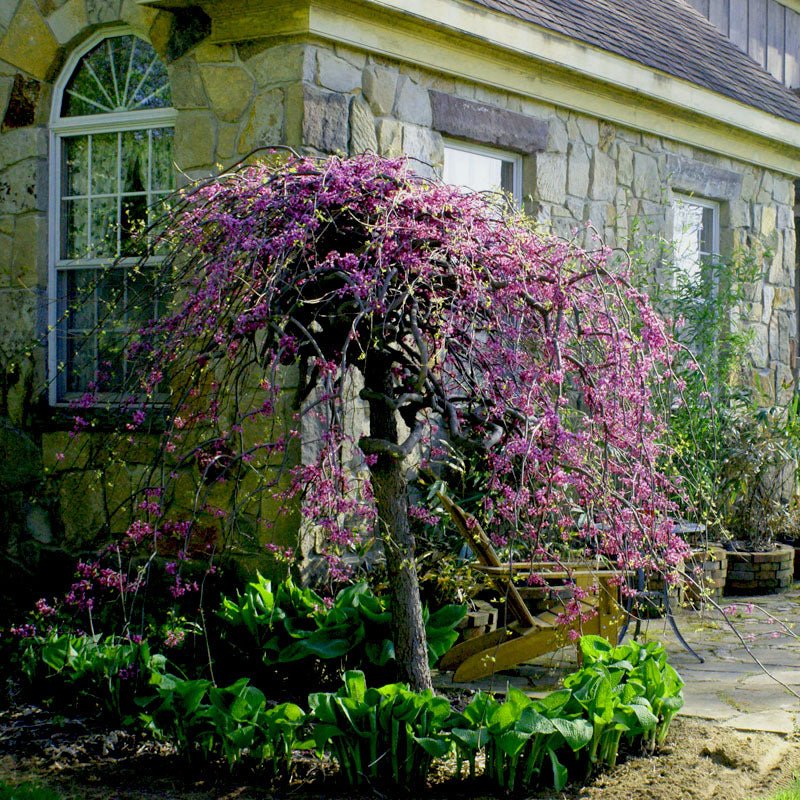
lavender twist weeping tree Lavender Twist Weeping RedbudForm and Flowers Lavender Twist Weeping Redbud Small, Cascading Accent Tree Beautiful Pink Flowers in Spring Amazing Fall Color Attracts Butterflies & Hummingbirds Versatile in the Landscape Living Sculpture! Heart Shaped Leaves Unique Zig Zag Stems Easy Care Full Sun to Part Shade It's nearly impossible to resist the charm of this tiny, adorable tree. With its amazing spring and fall color and unique umbrella shape, the Lavender Twist Weeping Redbud

Form and Flowers Lavender Twist® Weeping Redbud

  • Small, Cascading Accent Tree
  • Beautiful Pink Flowers in Spring
  • Amazing Fall Color
  • Attracts Butterflies & Hummingbirds
  • Versatile in the Landscape
  • Living Sculpture!
  • Heart-Shaped Leaves
  • Unique Zig-Zag Stems
  • Easy-Care
  • Full Sun to Part Shade

It's nearly impossible to resist the charm of this tiny, adorable tree. With its amazing spring and fall color and unique umbrella shape, the Lavender Twist® Weeping Redbud tree (Cercis canadensis 'Covey') packs a lot of interest into a small plant!

The impact is accentuated by the weeping, twisted branches tipping towards the ground. This tiny tree explodes in the spring with electric lavender flower clusters cascading along the bare, weeping branches in early spring.

You'll be amazed how quickly hummingbirds and butterflies will flock to its fragrant branches. They'll adore the early nectar source!

As the season transitions into summer, the density of the Lavender Twist®s canopy becomes another very attractive feature. Large, dark, heart-shaped leaves cover the plant all through the growing season.

The leaves have a glossy upper surface and will shimmer in the sunlight. The brilliant yellow fall color adds another highlight to the performance.

No matter how large - or how small - your landscape is, there is always room for a Lavender Twist® or two.

We sell out of this fabulous tree every single year. If you see it in stock, order today to avoid disappointment!

How to Use Lavender Twist® Weeping Redbud in the Landscape

It's easy to use this versatile, endearing tree in many places in the landscape. It makes an incredible focal point as a living sculpture. It can also be used as a very effective accent tree.

Use Lavender Twist® to block out unwanted low views in the garden. You can think of it as a cute, little screen to give strategic privacy.

You'll love the way this pretty plant helps you relax on your patio. Plant it behind a loveseat or near a side door to boost your sense of space. Even if you can't plant it in the ground, it will do well when grown in a container. Use one of the enormous commercial-grade containers available now for decades of enjoyment.

Include one or more in your front yard. It's wonderful as a small tree in a foundation planting. Try it at the corner of your house, situated 15 feet away from the exterior wall. It will be a graceful accent to welcome guests.

Plant several Lavender Twist® along a rocky slope, then, simply allow the branches to grow long and cascade down to soften the wall. This tree can add a bold touch of drama without much extra care beyond providing water as needed.

Or, use 3, 5, or 7 in a berm (large raised mound) planting. We would advise grouping them into smaller clusters for the most natural look. If you use 7, for instance, try a group of 3 in a loose triangle. Then, give breathing room between another group of 4.

This tree has such a sculptural look with its twisting and turning branches. Give each one some breathing room with at least 10 feet between each plant.

Before you plant, draw out your plan on paper. Once your plants arrive, take another moment to place each tree while it's still in the container.

You'll also want to study each of your plants. Decide which trees you'll partner up together. Decide which direction you want each tree to face.

You really, truly can't go wrong or make a mistake with the Lavender Twist® Weeping Redbud.

For a unique screen, plant a row of them 6 - 8 feet apart and let the branches grow down to the ground. This will be an interesting feature all year long. Even in winter, the zigs and zags of the branches will draw your eye.

No matter where you place them, they will look amazing and add so much character. Order now and enjoy!

#ProPlantTips for Care

Lavender Twist® Weeping Redbud tree does require well-drained soil. If puddles remain on your soil after a rain or watering, consider elevating the planting area. Add 18 - 24 inches of soil above the native soil line and plant your tree directly in that mound.

Please don't plant your tree too low in the soil. For container plants, plant at the same level as the nursery soil line. For bareroot trees, look for the color change (soil line) and plant at that depth.

For best results in warm, dry climates, give protection from the hot afternoon sun. Provide a 3-inch deep layer of mulch. You'll start about 2 inches away from the trunk and apply mulch thickly all around the tree to a distance of 3 feet outside the canopy. This will keep the root system nice and cool.

Give it regular summer watering. This is especially important in hardiness Zones 9 - 10.

In the fall, you'll appreciate how quickly the leaves drop once the plant goes dormant. This makes fall cleanup a breeze.

Staking Tips for Young Trees

This beautiful plant naturally grows as a 5-foot-high groundcover, spilling over the ground if left to its own devices. It will spread out over a wide area and can cascade over walls.

But the expert growers at Nature Hills will field train the plant into a small tree with a sturdy trunk that grows upright. The head of the tree will be comprised of downward cascading branches.

Staking Lavender Twist® as a young plant will help continue to develop the height of the trunk. Train it to grow as tall as you'd like.

We do recommend that you keep it staked until the trunk is at least 4 to 5 feet tall. You can even keep it tied to a 10-foot bamboo pole until the trunk is 8 feet tall.

Check the tying tape regularly to ensure it doesn't grow too tight. Retie if you need to as your tree trunk thickens up in caliper.

You can also influence the look of the branches with easy pruning techniques.

Pruning Tips for Lavender Twist® Weeping Redbud

Prune your tree after flowering to direct the spring growth and allow airflow into the canopy.

As the plant matures, fall pruning is required to remove dead, weak, or crossed limbs inside the dense canopy. This will help maintain good airflow.

You also need to decide how long you want to let the branches grow.

Some people allow the cascading limbs to grow to the ground, where they spread out as ground cover around the base of the tree. This bold look grabs attention in any landscape, especially if you have a slope or rock wall.

Lavender Twist® also looks incredible when the straight trunk is exposed. You can prune the lowest branches right back to the main trunk. You can create a manicured umbrella tree by pruning the weeping laterals at the same length all around.

Any way you want to grow it, Lavender Twist® creates a spectacular look in the garden. Place your order now!

Explore More from Nature Hills

If you're drawn to the unique charm of the Lavender Twist® Weeping Redbud, consider exploring other redbud trees and flowering trees that bring spring color to your landscape. For comprehensive care guidance, check out our #ProPlantTips: Best Redbud Tree Varieties & Care Guide and Magical Weeping Trees & How To Care For Them! for specialized advice on weeping varieties. You might also appreciate browsing our collection of native plants to complement this North American beauty in your garden design.

Shipping Notes
  • Free Standard Shipping on $100+ Orders to the USA.
  • Except Preorder products are shipped in 48 hours.
  • Delivery to the USA:
  1. Standard Shipping : 3-10 business days
  • If time is of the essence, please consider selecting expedited delivery for faster service.
Exchange/Return Notes
  • We offer a 30-day return/exchange service after receiving.
  • Final sale items are not eligible for returns or exchanges.
  • To process your return/exchange, please contact us at [email protected]
  • Please click here for more details>>> Return & Exchange Policy
SKU: 48918588928

Discover Niche Categories That Outsell lavender twist weeping tree

Top-Converting Item to Boost Your Average Order

4.2 ★★★★★
Based on 5 reviews
Sort
Highest Rating
Newest First
Oldest First
Product Reviews
J
Verified Purchase
Jack Hicks
Charlottesville, US
★★★★★ 4
interesting science
Format: Hardcover
Under A White Sky, The Nature of The Future, Elizabeth Kolbert, 2021 In 2015 Elizabeth Kolbert won the Pulitzer Prize for her book the Sixth Extinction. In my review of that book, I wrote: Kolbert is not a scientist but a reporter and writer for The New Yorker magazine and as such her book is structured as a series of bylines as she travels around the world reporting on scientists investigating extinctions in both the present and the past. As in that book she adopts the same format but this time investigating “how the very sorts of interventions that have imperiled our planet are increasingly seen as the only hope for its salvation”. Ice cores from the Antarctic and Greenland have shown that the last 10,000 years of earths history have been the most benign and stable climatological periods in the last 100,000 years. During this time, we have been able to develop agriculture, an amazing technological and a pervasive globe encompassing culture with a population now of almost 8 billion people. Without this unusually stable climate most of our current civilization would probably have not evolved or been possible. Up to this point we humans have taken this for granted thinking that this benign state will somehow last forever. In Kolbert’s last book she emphasized that due to our own rapacious destruction of earth’s ecosystems and our destabilization of climate stability, this situation is coming to an end and not responding is not an option. Facing an unimaginable crisis of our own making how should we respond? When we intervene, are we smart enough not to cause newer unanticipated problems greater than the original problem we sought to solve? Kolbert travels around the world seeking an answer to this question. She visits places and examples where we historically have tried to solve problems such as sewage in Chicago or taming floods on the Mississippi only to create larger problems such as invasive species or sinking cities such as New Orleans. The most interesting part of her book is when she addresses the people and places that are using current cutting-edge technology to save ecosystems and reverse global warming. One such example is on the Great Barrier Reef of Australia, one of the most diverse and prolific ecosystems on earth, which is under dire threat from oceanic warming and acidification. Faced with the real possibility of extinction of the reef in just decades, scientists are turning to genetic modification of Corals to make them more resistant to these fast-changing conditions. Since 2012 a new gene editing technology called CRISPR-Cas has become ubiquitous. In fact, so ubiquitous that you can buy your own “genetic engineering home lab kit” from a company in California called Odin for $1800. Kolbert buys her own kit and is able to engineer a colony of E. coli bacteria into a strain that is resistant to streptomycin antibiotic. She then inserts a jellyfish gene into yeast which then glows in the dark. Sound dangerous? Yes, what could possibly go wrong, but this is also the technology to develop new global warming resistant corals or destroy malaria carrying mosquitos, control rapacious rodents on Pacific Islands or control a plague of Cane Toads in Australia, not to mention breakthrough medical benefits. We have so altered natural systems with invasive species, with climatological chaos that the only solution is further intervention. She quotes a scientist at the Australian Animal Health Laboratory: “What people are not seeing is that this is already a genetically altered environment. Invasive species alter the environment by adding entire genomes that don’t belong. By contrast Genetic engineers, by contrast, alter just a few bits of DNA here and there”. “The classic thing people say with molecular biology is: Are you playing God? Well no. We are using our understanding of biological processes to see if we can benefit a system that is in trauma”. Do you feel guilty about all the carbon you are emitting into the atmosphere when you drive around in your SUV or eat a filet mignon? Now there is a way to assuage your guilt. There is a now a company called Climeworks that will do just that for the price of $1000 per ton of sequestered CO2. Being that each American emits about 20 tons per year following the American way of life and to totally assuage your guilt will cost you a cool $20,000 per year. Do you feel that guilty? Kolbert purchases one ton of sequestration and then visits the place where the deed is done which turns out to be at a geothermal power plant in Iceland. There they inject CO2 into the hot molten basalt at the bottom of their well to form limestone. This is a way the earth has been doing this process for millions of years without payment. In fact, it is the very process that transpired when the Himalayas were pushed up by the Indian subcontinent million of years ago, sequestered billions of tons of carbon into limestone and enabled the ice ages to begin 3 million years ago. Is this process a feasible solution to our current crisis? According to the latest UN climate report at this point, some form of sequestration is almost certainly required to avoid a catastrophic global temperature rise above 2 degrees regardless of what green technologies are introduced. Almost certainly the cost of that sequestration will have to be drastically reduced. Is there another way to approach the problem? Here Kolbert interviews scientists who are studying a process called solar geoengineering which involves shooting reflective compounds or crystals into the stratosphere to reflect sun light and reduce the earths albedo or heat absorption. This the same process that occurs when large volcanic explosions expel billions of tons of dust and S02 that block incoming sunlight and cool the planet. Last time a truly global volcanic eruption occurred was Tambora in Indonesia in 1815 and caused catastrophic cooling causing mass famine in various places around the world. Is this a feasible solution? Maybe, certainly not to the extent of Tambora and one side effect might be changing the sky from blue to white and hence the title of the book. Sunsets might be improved however. This a short book and quick read and one gets the sense that it was somewhat truncated because of the pandemic restricting travel. However, there is still a lot of interesting information about the future fate of our planet and what can be done to ameliorate the damage that we have inflicted. JACK
WAS THIS REVIEW HELPFUL?YesReportShare
Reviewed in the United States on March 1, 2021
F
Verified Purchase
Fern
Whiting, US
★★★★★ 5
I like it
Format: Paperback
In very good condition
WAS THIS REVIEW HELPFUL?YesReportShare
Reviewed in the United States on March 25, 2026
M
Verified Purchase
Mr. Stripey
Los Angeles, US
★★★★★ 5
Informative studies of how scientists are trying to address environmental issues today
Format: Paperback
In this book Kolbert travels to visit scientists attempting to address the environmental changes that humans are creating on the planet. The chapters focus on different issues, such as invasive species, and species loss, and includes field site visits, and also references for more reading. If you read this, and Sixth Extinction, and Field Notes From a Catastrophe, you will get a great oversight of some of the environmental issues that we face, although not any neat solutions. All the case studies build up into a wider understanding.
WAS THIS REVIEW HELPFUL?YesReportShare
Reviewed in the United States on December 23, 2023
D
Verified Purchase
Dave of Dublin
Battle Creek, US
★★★★★ 3
disappointing
Format: Hardcover
I was excited to read "Under a White Sky". Unfortunately, it seems that the author just sort of stopped writing when COVID hit. See page 197, where author laments the arrival of COVID. FOur pages later, book ends. The author even says on page 197: "Here I was, trying to finish a book about the world spinning out of control, only to find the world spinning so far out of control that I couldn't finish the book". Couldn't finish the book, but COULD publish it and sell it to people like me. The early chapters are interesting, each one covering a different topic related to man messing with nature. Good stuff. But I expect some analysis, some conclusion, something to sum it all up. It just isn't there. Topic and early chapters showed great promise. But the ending is truly lacking. And as the author alludes, unfinished.
WAS THIS REVIEW HELPFUL?YesReportShare
Reviewed in the United States on March 7, 2021
I
Verified Purchase
Immer
Grantham, US
★★★★★ 4
As A Dominant Species, We Dance On The Razor’s Edge
Format: Hardcover
Under A White Sky Elizabeth Kolbert’s claim to fame is her book The Sixth Extinction. In comparison Kolbert’s under A White Sky is rather short and disorganized, yet her coverage of those working on solutions to Climate Change is pretty darn interesting.  In her conclusion, she writes, “This has been a book about people trying to solve problems created by people trying to solve problems.” Putting this sentence at the book’s beginning rather than buried at its end would have provided a reader a compass to help determine where Kolbert was going with her dialogue. As she wades through the reversed direction of the Chicago river; Asian carp; Cane toads; forced and accelerated evolution in regard to coral, in particular in regard to the Great Barrier Reef (without discussing the importance of the worlds reefs; the continual flooding of New Orleans both despite and because of the actions of The Army Corps of engineers, one begins to ponder a general connection that might exist, while the book itself is headed toward a two star rating. Then, Kolbert got to Global Warming and Climate science. The book’s last sixty pages are worth the complete price of admission. The chapter begins with carbon sequestration, the pros and cons of how it can be done, and does it also contribute to the growing problem. The stoppered bathtub” analogy is perhaps the best analogy I’ve heard in regard to the anthropocentric carbon dioxide problem on the Earth. The tub is full of water/ the sky’s CO2 level; the tubs stoppered, so the water isn’t going anywhere, and the atmosphere’s increased CO2 level won’t drop in the near future either; and even if the water flow to the tub is reduced, it will still accumulate until over flowing, as will reduced emissions continue to amass in the atmosphere. In a sense, we are already beyond the tipping point in terms of global temperature increase. Harvard University Center for the Environment director Dan Schrag says, “I’m a scientist. My job is not to tell people the good news. My job is to describe the world as accurately as possible.” He predicts, due to the fact that the oceans must equilibriate. “If we were to stop CO2 emissions tomorrow, which of course isn’t possible, it’s still going to warm for centuries. That’s just basic physics.” Thus enters the topic of geoengineering, and the connection with people trying to solve problems created by people trying to solve problems truly comes into focus. Kolbert , in a rather clandestine way connects the dots of her past “local problems”, but now the problem fix, if it doesn’t work could create problems beyond solving. She hits the nail on the head with this. Humans have been around 35-50 thousand years, but only the last ten thousand or so have they thrived, largely due to agriculture and differentiation of what one can do because of agriculture. But ag has only been able to thrive because of the rather consistent global weather of the past ten thousand years, due to glacial retreat. This has been presented in great detail by Jared Diamond in his book Guns, Germs, and Steel. The CO2 we’ve put into the atmosphere isn’t going anywhere, as we continue to pour more into the mix. Her interviews with climate scientists do not bode well for our species, as everything they think of to combat the CO2 conundrum brings more as the bathtub continues to fill. One could say humans have become victims of their own success as a species. Ultimately, one gets the feeling from Kolbert and her interviews, that the enormous fluctuations in the Earth’s climate over geological time, and those yet to come, render whatever we do as humans as a moot point. The Earth will shake is off as a dog rids itself of fleas. She also brings to the argument, when the blank really hits the fan, as it will despite, or because of any preventative efforts by man, the resulting population displacements will be staggering. A sobering, informative book as we, as a species, dance on the razor’s edge.
WAS THIS REVIEW HELPFUL?YesReportShare
Reviewed in the United States on September 24, 2021

recommand products