SKU: 63444279893
buy variegated fiddle leaf fig

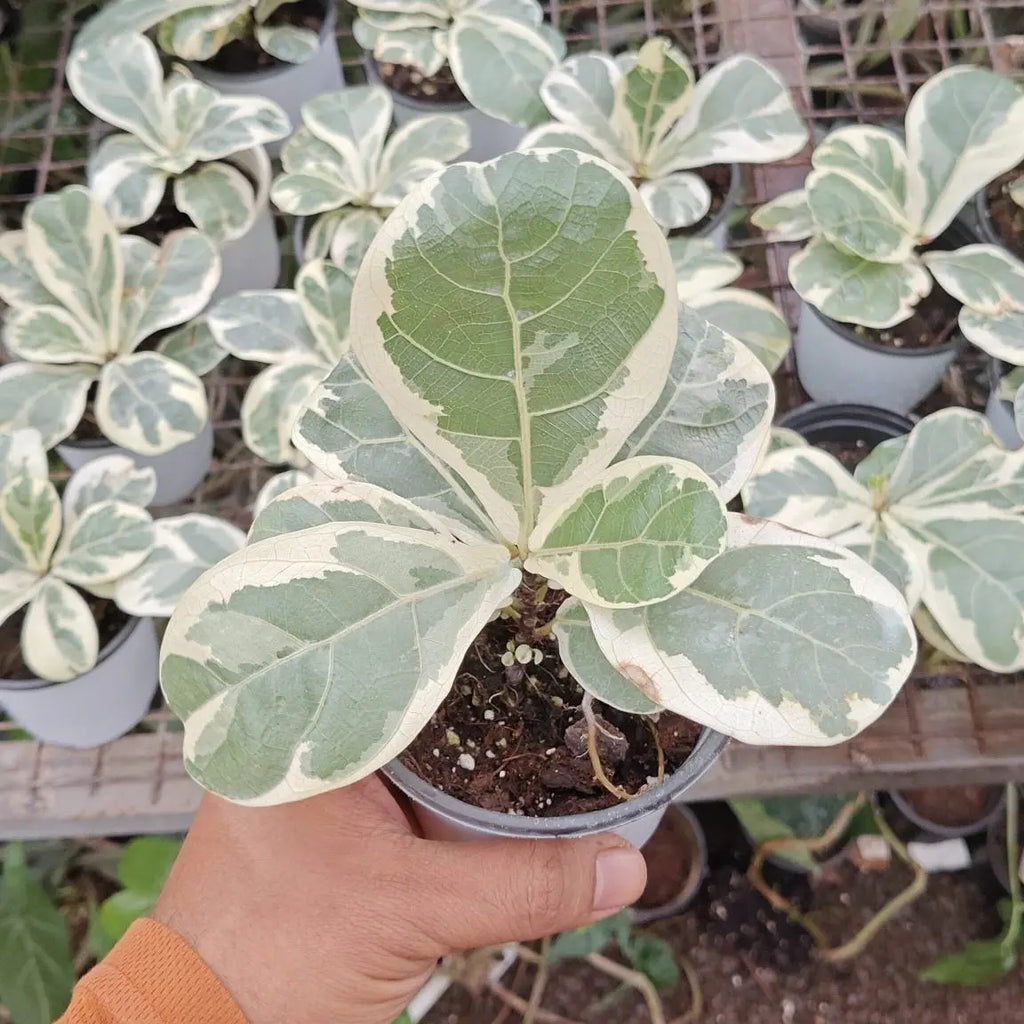
buy variegated fiddle leaf fig Variegated Ficus Lyrata (Variegated Fiddle Leaf Fig)

Sale price$25.53 Regular price$28.37
Save 10%

Pay in installments of $7.09 with ShopPay, AfterPay and Klarna

Shipping Estimate
USA
  • USA
  • CAN

Ships within 48 hours · Estimated delivery Sep 29 - Oct 4

Promo Codes Available:

For Your Every Summer RSVP, with Code: SUMMER15

Description

buy variegated fiddle leaf fig Variegated Ficus Lyrata (Variegated Fiddle Leaf Fig)The Variegated Ficus Lyrata the Variegated Fiddle Leaf Fig is among the rarest houseplants in the world. The standard Fiddle Leaf Fig is already beloved for its enormous, lyre shaped leaves lyrata, Latin for lyre, the instrument its leaf silhouette resembles and the variegated form takes those same dramatic leaves and layers them in an irregular, tri tonal pattern of dark glossy green at the centre, soft olive green in between, and sweeping cream to

The Variegated Ficus Lyrata — the Variegated Fiddle Leaf Fig — is among the rarest houseplants in the world. The standard Fiddle Leaf Fig is already beloved for its enormous, lyre-shaped leaves — lyrata, Latin for lyre, the instrument its leaf silhouette resembles — and the variegated form takes those same dramatic leaves and layers them in an irregular, tri-tonal pattern of dark glossy green at the centre, soft olive-green in between, and sweeping cream-to-white margins and patches toward the edges. Native to the lowland rainforests of West Africa, it grows into a sculptural, upright tree of 1.5–3 m indoors. Commercially, it is produced by only a handful of specialist growers, primarily in Thailand. Owning one is a genuine statement of collection.

⚠️ The Golden Rule — Find Its Spot and Leave It There The Variegated Fiddle Leaf Fig is acutely sensitive to being moved, rotated, or disturbed. Each time its orientation to light changes, it must recalibrate — and during that adjustment it drops leaves. Choose the brightest, most stable position in your home, place it there, and do not move it again unless absolutely necessary. Even turning it to ensure even growth is not recommended until the plant is fully settled. Consistency is everything with this plant.
💡 Cream Sections Have Less Chlorophyll — What This Means The cream and white variegated areas cannot photosynthesise. The plant relies entirely on its green sections for energy — making it a slower grower than plain Ficus lyrata and more sensitive to low light. It also means the cream sections scorch and brown faster than the green in direct sun or dry air. Bright, consistent, indirect light is the non-negotiable foundation of good care.
☀️

Light

▾

The brightest spot in your home — as close to a window as possible without direct sun touching the leaves. An east-facing window or a south/west-facing window with a sheer curtain is ideal. 6–8 hours of bright filtered light daily. Gentle morning or late afternoon sun can be tolerated once the plant is established. Never move the plant once settled — position it correctly from the start.

💧

Watering

▾

Allow the top 50% of soil to dry before watering — roughly every 10–14 days. Water thoroughly with lukewarm filtered or rainwater until it drains freely, then empty the saucer. The variegated form is more sensitive to over and underwatering than the plain green — a moisture meter is a worthwhile investment. Maintain a consistent watering schedule; irregular watering triggers leaf drop.

💦

Humidity

▾

50–70% preferred. A humidifier nearby is ideal — the cream sections show edge damage sooner than the green in dry air. Keep well away from AC vents, fans, radiators, and heating sources. Do not mist directly — water on the leaves promotes bacterial and fungal infections, to which Ficus lyrata is particularly susceptible.

🌱

Growing Media

▾

Light, fast-draining mix: 50% quality potting soil, 30% perlite, 20% orchid bark. pH 6.0–7.0. A pot with excellent drainage holes is non-negotiable — standing water at the roots is the primary cause of root rot. The plant prefers to be slightly root-bound; repot only when roots visibly emerge from drainage holes, moving up one pot size in spring.

🌾

Feeding

▾

Balanced liquid fertilizer at half strength every two weeks in spring and summer. Use lukewarm water. Stop feeding entirely in autumn and winter. Over-feeding causes leaf drop — less is more. Wipe the large leaves with a soft damp cloth monthly to remove dust, which impedes photosynthesis.

⚠️ Common Issues & Quick Fixes

Leaf Drop

▾

The most common Ficus lyrata complaint — triggered by being moved, rotated, cold drafts, irregular watering, or low light. Identify and fix the cause, then leave the plant completely undisturbed. New leaves will emerge once conditions stabilise. Do not overwater in response to stress — this compounds the problem.

Brown Spots or Edges on Cream Sections

▾

Direct sun, dry air, or tap water minerals. Move to pure indirect light, boost humidity, and switch to filtered or rainwater. Do not mist — it causes bacterial spotting. Existing brown areas are permanent; new growth will be healthy once conditions improve.

Brown Spots with Yellow Halo — Bacterial Infection

▾

Bacterial leaf spot — the most serious Ficus lyrata disease. Caused by overwatering, misting, or poor drainage. Remove affected leaves immediately with clean scissors. Reduce watering significantly, improve drainage, stop all misting, and ensure good air circulation. Do not let water sit on the leaves.

White Raised Dots on Leaves

▾

Completely normal — these are cystolyths, natural calcium carbonate crystal deposits in the leaf cells. They cannot be wiped off and require no treatment. Do not mistake them for pests or disease.

Spider Mites or Scale

▾

Inspect leaf undersides and stems regularly. Wipe with a soft damp cloth then treat with diluted neem oil or insecticidal soap every 5–7 days for 3 weeks. Maintain humidity above 50% to deter spider mites. Do not spray neem oil in direct sunlight.

📋 Quick Plant Profile

Botanical Name Ficus lyrata Warb. 'Variegata'
Name Meaning lyrata = Latin for lyre — the leaf silhouette resembles the ancient stringed instrument
Family Moraceae (mulberry family)
Origin West Africa; lowland tropical rainforest
Variegation Pattern Tri-tonal: dark green centre, olive-green mid, cream-to-white margins and irregular patches
Rarity Extremely rare — commercially produced by specialist growers primarily in Thailand
Golden Rule Find its spot and do not move it — position changes trigger leaf drop
Light Brightest spot available; bright filtered; no direct midday sun; do not rotate
Watering Top 50% dry; lukewarm filtered water; consistent schedule; no saucer standing water
Humidity 50–70%; humidifier preferred; no misting — causes bacterial leaf spot
Temperature 18°C–27°C; stable and consistent; no cold drafts or sudden changes
Mature Height 1.5–3 m indoors; up to 25 m in the wild
Pot Preference Slightly root-bound; repot only when roots emerge from drainage holes
Do Not Mist Water on leaves causes bacterial leaf spot — use humidifier instead
White Dots on Leaves Cystolyths — natural; not pests; do not treat
Ideal For Serious Collectors, Statement Indoor Trees, Bright Living Rooms
Care Level Advanced — consistency and stability are the foundations of success
Shipping Notes
  • Free Standard Shipping on $100+ Orders to the USA.
  • Except Preorder products are shipped in 48 hours.
  • Delivery to the USA:
  1. Standard Shipping : 3-10 business days
  • If time is of the essence, please consider selecting expedited delivery for faster service.
Exchange/Return Notes
  • We offer a 30-day return/exchange service after receiving.
  • Final sale items are not eligible for returns or exchanges.
  • To process your return/exchange, please contact us at [email protected]
  • Please click here for more details>>> Return & Exchange Policy
SKU: 63444279893

Discover Niche Categories That Outsell buy variegated fiddle leaf fig

Top-Converting Item to Boost Your Average Order

4.6 ★★★★★
Based on 25 reviews
Sort
Highest Rating
Newest First
Oldest First
Product Reviews
M
Verified Purchase
Moon Riley
Cuba, US
★★★★★ 5
Sugar free
Tastes great
WAS THIS REVIEW HELPFUL?YesReportShare
Reviewed in the United States on April 21, 2026
M
Verified Purchase
Mr. Paul A. Ackermann
Grantham, US
★★★★★ 5
Dude, it's not just a horror novel
Format: Paperback
This is to the previous reviewer (C. Scanlan). If this is just a horror novel, it failed miserably. It is not exactly a blood ’n gore thriller. Compared to Stephen King, it is pretty tame. What puts the horror in this book is that it is social commentary. Mary Shelly is not just trying to scare us. It is more than just a “Friday the 13th” movie. Mary Shelly is delivering a message. It seems that everyone understands this except this reviewer. There have been several different interpretations of the novel (see [...] for 10 different meanings of the novel). ICE takes the interpretation that Shelly is saying science can go too far. This is a perfectly valid interpretation. One can disagree with this interpretation but let’s not resort to name calling and personal attacks – that those who hold such an interpretation are doing a “low level attempt to cash in on home schooling Christian paranoia and fear of health care” or believe that “AIDS [is] the fruit of sin”. My wife and I are Catholic parents and we sent our children to public schools He mocks the idea of a secular fundamentalist but then demonstrates what that is. A religious fundamentalist sees anyone who disagrees with him as being of the devil. A secular fundamentalist sees anyone who disagrees with him as guilty of “brainwashing” others. In both cases, true dialogue is impossible. Another thing that a fundamentalist does is that he sees things in opposite extremes. If you are warning of the dangers of trusting too much in science then you must be against science. There is no middle ground for the fundamentalist. If you see that science can sometimes go too far then that means you are against health care. But this is a non-sequitur. Nielson writes “Frankenstein’s placing of the creation of life within the scientific method first destroys the unrepeatability and systematically eliminates the other elements [of hope, love, beauty, creativity and sacrifice]”. Nielson is not criticizing the scientific method in total. He is only criticizing it in the creation of life. The reviewer writes “He thereby easily and explicitly condemns the whole process and philosophy of the scientific method”. But Nielson is not condemning the whole process of the scientific method. He is only condemning it in the creation of life. The reviewer then mocks the credentials of the critics in the book - “So who are these essayists superior to Norton's and Oxfords and free of deconstructionist feminist secular fundamentalism, experts so august Ignatius should want them mentioned on their product page yet are nowhere to be seen?” But this game can be played both ways. What are the credentials of this reviewer? Is this reviewer so august as to challenge these essayists? Again, this is merely an ad-hominem attack. I really do not care who has the best credentials. What matters is who makes sense. Sometimes intellectuals can make the dumbest claims. Read Paul Johnson’s book, “Intellectuals” (http://www.amazon.com/Intellectuals-Marx-Tolstoy-Sartre-Chomsky/dp/0061253170/ref=sr_1_1?ie=UTF8&qid=1421862888&sr=8-1&keywords=intellectuals). He compares the essayists unfavorably to “good solid Roman Catholic moral theology” from the likes of Richard A. McCormick S.J., who “is the renowned leader of Roman Catholic Moral Theology in the field of bioethics in the USA.” He overlooks the fact that A. McCormick S.J. has dissented from teachings of the Popes Paul VI, John Paul II, and Benedict XVI over contraception. The “renowned leader” in the Catholic Church in morality is first and foremost the pope. Since Richard A. McCormick has contradicted the popes, he cannot be a good solid Catholic theologian. Mary Shelly lived right after the Enlightenment – man is the measure of all things. She lived at a time when people believed that science will solve all our problems. This is called scientism. ICE contends that Shelly is saying that we may be expecting too much from science. It does not mean that Shelly was saying that we should reject science. And it does not mean that Shelly believes that we should go back to the Catholic faith. In fact, ICE acknowledges that Shelly was an anti-Catholic. But the Church believes that the kernel of truth can be found in others, even in anti-Catholics. This is part of the Catholic tradition. St Augustine learned from Plato and St Aquinas learned from Aristotle. ICE would take that kernel of truth and expound that with the fullness of the Catholic faith. You may disagree with the Catholic faith, or with ICE looking at Shelly’s book from a Catholic perspective. But this is at least as a legitimate an interpretation as any other. In fact, this interpretation seems closer to the truth than the others. This interpretation is the traditional interpretation, which means that it goes back further to Shelly’s time than the modern interpretations, and is therefore less likely to be in error. BTW, the reviewer wrote that “Opus Dei right wing publishing (or reprint) house is selling this novel is to milk the home school market and to support its own bizarre bio-ethical ideology”. This is factually wrong. The company that publishes Opus Dei’s books is Sceptre. But the publisher of ICE is Ignatius Press.
WAS THIS REVIEW HELPFUL?YesReportShare
Reviewed in the United States on January 22, 2015
R
Verified Purchase
RC Mom
Louisville, US
★★★★★ 5
Good experience
Format: Paperback
It was all good.
WAS THIS REVIEW HELPFUL?YesReportShare
Reviewed in the United States on November 24, 2025
B
Verified Purchase
Brian J. Buckley
Natrona Heights, US
★★★★★ 4
Love the Edition and Footnotes; Don't need the Cultural Criticisms
Format: Paperback
The layout of the book and the footnotes are each great. What mars the book, unfortunately, is the editor's need to make simplistic statements about cultural elements. Several times, for example, he addresses "feminism," even using the term "Franken-feminists" in a puerile manner at one point. As too many of these conservative Catholics do, he simplifies and comments about modern culture without nuance. In this case, it is simply unprofessional and inaccurate (i) to not capture the myriad differences in feminist thought (many of which he and his readers would accept) and (ii) thereby to make all feminists the same (e.g,, assuming the feminists of the 1970's are the same as today's.) This is all unfortunate because when he is just addressing the literary elements of the book, his comments are wonderful and helpful to the reader. Any reader should know that this presentation will be tilted in an unsophisticated and simplistic way toward a traditional Catholic view (a view that can indeed be defended well while still being careful and charitable to critics). With that caveat, he (or she) should still buy it and garner a good edition of the text.
WAS THIS REVIEW HELPFUL?YesReportShare
Reviewed in the United States on March 12, 2024
A
Verified Purchase
ABH
Birmingham, US
★★★★★ 5
Great edition
Format: Paperback
Love Ignatius critical editions. There are so many scholarly essays that are so vague and uninteresting, or worse, try to de-construct the writer's work. Ignatius critical editions' essays are wonderful and do not miss the timeless point of the great literature the series brings forth.
WAS THIS REVIEW HELPFUL?YesReportShare
Reviewed in the United States on April 10, 2016

recommand products