Pay in installments of $5.02 with
 ,
,
 and
and

Shipping Estimate
USA
- USA
- CAN
- USA
- CAN
Ships within 48 hours · Estimated delivery Sep 25 - Sep 30
 Promo Codes Available:
For Your Every Summer RSVP, with Code: SUMMER15
Description
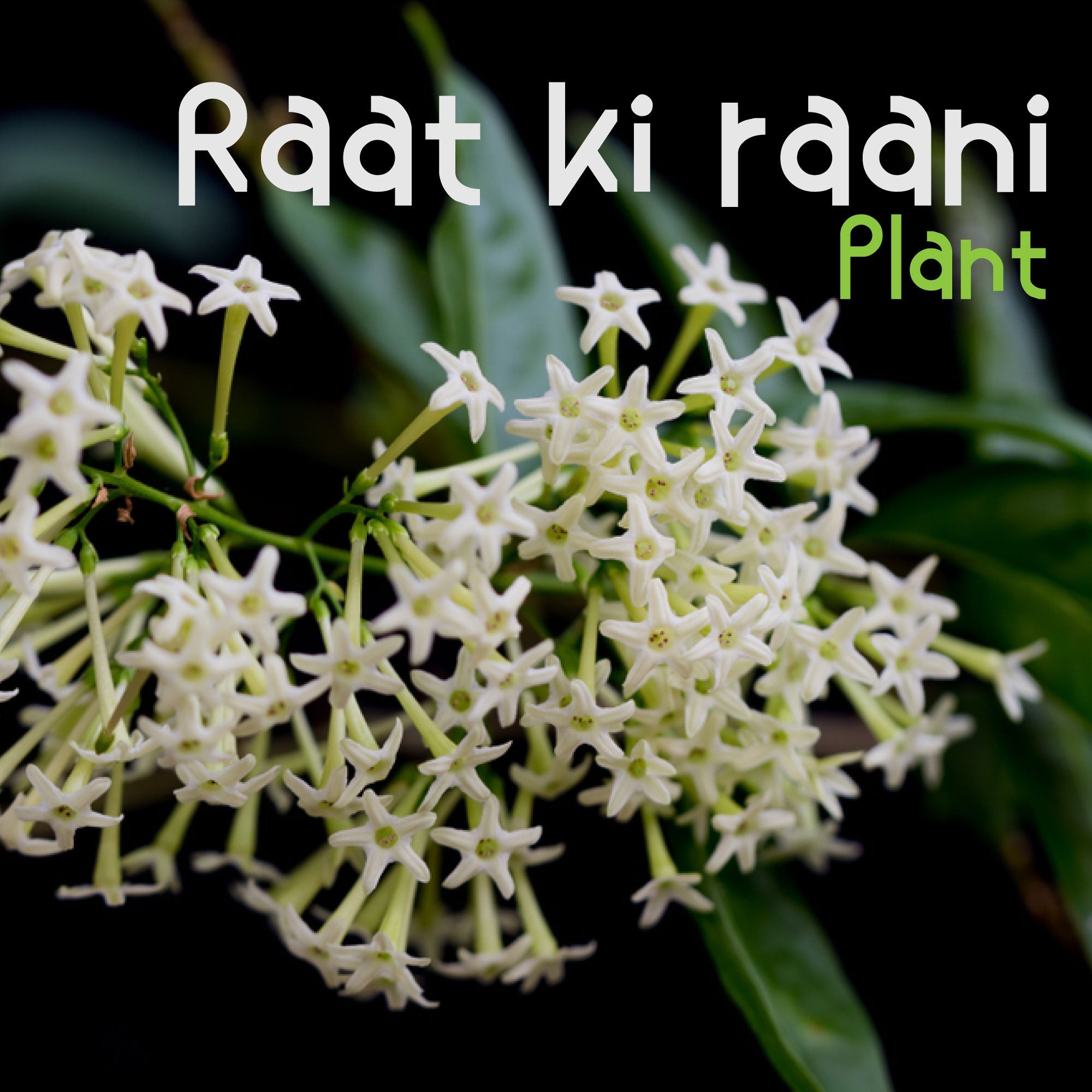
raat ki rani plant and snakes Buy Raat Ki Rani | Night Blooming JasmineIntroduction of Raat Ki Rani Plant Night Blooming Jasmine: Raat Ki Rani Plant i. e Night Blooming Jasmine is a type of Jasmine Plants that bears beautiful white yellow flowers and produces fragrances at night time. It is native to the West Indies but commonly found in South Asia and belongs to the potato plant family Solanaceae. The scientific name of night blooming jasmine is Cestrum Nocturnum and is well known as Lady of the night and famous for
Introduction of Raat Ki Rani Plant- Night Blooming Jasmine:
Raat Ki Rani Plant i.e Night Blooming Jasmine is a type of Jasmine Plants that bears beautiful white-yellow flowers and produces fragrances at night time. It is native to the West Indies but commonly found in South Asia and belongs to the potato plant family Solanaceae. The scientific name of night-blooming jasmine is Cestrum Nocturnum and is well known as Lady of the night and famous for Raat Ki Rani in South Asian countries. It grows as a decorative or ornamental plant and thrives best in a moderate climate with the application of moist soil.Specifications:
Size: Raat Ki Rani can grow up to 8-10 ft in height and 3 ft in wide Plant Type: Perennial Plant Family: Solanaceae Growing Difficulty Level: Raat Ki Rani is not hard to grow but requires proper attention i.e Growing Difficulty level is Medium. Names i.e Commonly Known as: Raat Ki Rani, Night Blooming Jasmine, Lady of the Night, Queen of the Night, Dama de Noche, Night Blooming Cestrum Bearing: White-Yellow Flowers Time to Bloom: In summer from July through October Botanical Name: Cestrum nocturnumBest Way to Care For Raat Ki Rani:
Best Practices to grow Lady of the Night effectively:Best Practices:
Ideal Temperature and Climate:
- It can tolerate cooler climates and the ideal temperature to thrive is 20°F to 30°F.
Ideal Sunlight:
- Raat Ki Rani needs partial to full sun to do its best.
Ideal Watering:
- It should be watered 2 - 3 times per week during the first season.
Ideal Soil:
- Well draining and sandy soil is best for the growth of Night Blooming Cestrum
Ideal Fertilizer:
- 15-15-15 fertilizer which has equal parts of Nitrogen, Phosphorus, and potassium is ideal for the Queen of the Night.
Things to do and don’t after planting of Raat Ki Rani:
Do’s:- Do watering regularly until established
- Fertilize the plant in early spring, and again in early summer and early fall with granular.
- Do not use a fertilizer that has a high amount of nitrogen that can harm the growth badly
- Do not place Lady of the Night in too much sunny or too much shady that causes the plant to wilt.
Frequently Ask Questions About Raat Ki Rani:
Q: How often a year does night-blooming jasmine flowers bloom?
Queen of the Night produces flowers 3 to 4 times a year. After that, it produces white berries full of seeds.Q: Why is my night-blooming jasmine leaves curling?
Lack of well-drained soil and lack of watering are the major causes of Night Blooming Cestrum leaves curling.Q: How do I prune Cestrum Nocturnum?
Lady of the Night should prune in spring by reducing its height and spread. Besides that, the stem needs to be cut 3 to 4-inch.Q: How do you revive dying night-blooming jasmine?
Cut out all the damaged roots and repot night-blooming Cestrum with fresh potting soil. The plant may recover in about two weeks.Q: What's eating my night-blooming jasmine?
Caterpillars and Aphids are the major plant insects that damage Night Blooming Cestrum However, caterpillars are responsible to cause considerable damage to the foliage and aphids can block your plant to bloom.Q: Can Night-blooming jasmine survive cold?
Cestrum Nocturnum can survive in the cold if there is no frost. The ideal temperature to thrive is 20°F to 30°F.Q: Where is the best place to plant a Night Blooming Cestrum?
Lady of the night requires a lot of space for its roots to spread out with the application of well-draining sandy soil. Moreover, it prefers partial to full sun and regular watering to thrive.Q: Is the queen of the night a perennial?
Queen of the Night is a perennial plant that grows white-yellow flowers and flowers bloom from July to October.Q: Why is my Cestrum nocturnum not blooming?
Uses of too much nitrogen fertilizers, plant pests attack, and not enough watering can block Cestrum octurnum to bloom. You should use low nitrogen fertilizer and follow best care practices to get good results.Q: Can you grow night-blooming jasmine inside?
You can grow queen of the night as an indoor plant, Cestrum octurnum is a good fit plant to grow in your house especially if you don't live in a tropical or subtropical area.References:
- https://www.gardeningknowhow.com/ornamental/shrubs/jessamine-plants/night-blooming-jasmine-care.htm
- https://dengarden.com/gardening/Night-Blooming-Jasmine-Cestrum-Nocturnum
- https://en.wikipedia.org/wiki/Cestrum_nocturnum
- https://sumogardener.com/night-blooming-jasmine-care/
Shipping Notes
- Free Standard Shipping on $100+ Orders to the USA.
- Except Preorder products are shipped in 48 hours.
- Delivery to the USA:
- Standard Shipping : 3-10 business days
- If time is of the essence, please consider selecting expedited delivery for faster service.
Exchange/Return Notes
- We offer a 30-day return/exchange service after receiving.
- Final sale items are not eligible for returns or exchanges.
- To process your return/exchange, please contact us at [email protected]
- Please click here for more details>>> Return & Exchange Policy
4.7 ★★★★★
Based on 23 reviews
Sort
Product Reviews
★★★★★ 5
An indispensible Hebrew Language resource.
Format: Hardcover
This book is an amazing resource for anyone who has completed preliminary Hebrew such as with Pratico and Van Pelt in their Basics of Biblical Hebrew. This book goes above and beyond, it gives the diagnostic origin patterns for adjectives, patterns in noun formation as well as other components of speech, contrasts each of the seven major verb forms and the minor forms as well, and gives an excellent evolution of the utilization of the Hebrew language and its update in characters.
It explains in its initial history a lot of unique statements in the Torah, and illustrations throughout give the reader an excellent idea about the Hebrew Scriptures. I bought this to aid in designing a language studies course at seminary and it has stood me in great help so far, going beyond anything I would have expected to get out of an intermediate level grammar and is an amazing, invaluable, and priceless resource, both to the professor, and the student. I recommend all people taking Hebrew purchase this book and add it to their collection and read it through cover to cover as well as using it as a topical reference guide.
WAS THIS REVIEW HELPFUL?YesReportShare
Reviewed in the United States on October 30, 2016
★★★★★ 5
can potentially be overwhelming
Format: Hardcover
This is a good resource for introduction to syntax. However, the vast amount of examples has benefits as well as disadvantages. The benefit is that it is comprehensive in information which makes it good for a reference. The disadvantage is that the many subcategories can cause one to be discouraged as the quantity of information may be overwhelming. Nonetheless that is the nature of learning a language.
It is still a good resource if you can maintain the brain power to understand the technical language if you have a novice background to linguistics. The volume could be more pedagogical however that would cater to the self learner and perhaps that was not the intent of the author. This volume seems to be designed for the classroom setting. However it is still decent for the self learner.
WAS THIS REVIEW HELPFUL?YesReportShare
Reviewed in the United States on June 30, 2014
★★★★★ 5
Favorite Hebrew Reference Book
Format: Hardcover
This is the Hebrew grammar that I use the most often. While I also use Williams and Arnold and Choi, this grammar is more comprehensive, and its size certainly reflects this. It probably betrays my inclination towards the exactness of Greek to like this grammar so much. As my Hebrew professor often tells us, all these grammar categories are contrived to some extent, so at some point it isn't helpful anymore to go further in depth on the uses of the so-called "cases."
All in all, I usually find it easy to locate the grammatical point in which I am interested, though sometimes I have to resort to looking up every instance a Hebrew particle occurs throughout the book. For this looking up of various nuances of a particle, I sometimes find Williams more user friendly. Nevertheless, Waltke and O'Connor's volume has been my resource of choice.
WAS THIS REVIEW HELPFUL?YesReportShare
Reviewed in the United States on November 6, 2012
★★★★★ 4
deep
Format: Hardcover
If you are a serious student of Hebrew this is the only way to go. The book explains how the language is built from the ground up. If you are like me you have found learning Hebrew challenging (that's a joke). I have tried learning vocabulary, rote memorization, even coming up with silly English sentences to help me remember words (The goddess "Hera" is quick) (sad, I know). This tool is essential approaching the language from the building block side of things and I am now able to look at the prayer book and recognize forms and tenses I never understood before. It is for the serious student who REALLY wants to learn the language.
WAS THIS REVIEW HELPFUL?YesReportShare
Reviewed in the United States on February 27, 2009
★★★★★ 5
Can't do Without
Format: Hardcover
I have been a fan of Gesenius for a long time. While I knew there was updated information to consider, I thought his text was enough. But although his text is certainly still necessary, and necessarily covers issues that the book reviewed here does not, it is clear that one must turn to Waltke & O'Connor to reach a greater level of accuracy. Writing so long after Gesenius, they have presented new and accurate information based on the latest research, not only of Ancient Hebrew, but also based on cognate Semitic languages.
I have found the sections on Hebrew verbs the most enlightening and correcting, e.g., that the Pi'el stem is NOT intensive. Such intenseness must be detected from a combination of the lexical verb meaning, the stem, and the text/co-text. This book also presents other up-to-date information on the forming of nouns from verbs, etc.
As others have noted, the layout and presentation is great. It really can't be presented any easier, I don't think.
One must read Gesenius, for he presents very important information across the board, including much on phonology and linguistics not covered by Waltke & O'Connor. But to stick with Gesenius will leave one in error on some points. Waltke & O'Connor, simply put, make the corrections and make studying Biblical Hebrew exciting, and even much easier to learn.
WAS THIS REVIEW HELPFUL?YesReportShare
Reviewed in the United States on January 13, 2004
recommand products
7-10 FT Snake Plant
20.79
Pothos Jessenia Bright
24.05
Potted 12" Snake Plant 'Zeylanica'
23.30
Popular Pothos Plants 6-pack: Trailing / Hanging Vines & Variegated Plants - (2” Pots) - Golden Pothos - Marble Queen Pothos - Neon Pothos
23.80
Popular Pothos Plants 4-pack: Easy Hanging Vines & Variegated Plants - (4.25” Pots) - Golden Pothos - Marble Queen Pothos - Neon Pothos
23.32