Pay in installments of $7.01 with
 ,
,
 and
and

Shipping Estimate
USA
- USA
- CAN
- USA
- CAN
Ships within 48 hours · Estimated delivery Aug 29 - Sep 3
 Promo Codes Available:
For Your Every Summer RSVP, with Code: SUMMER15
Description
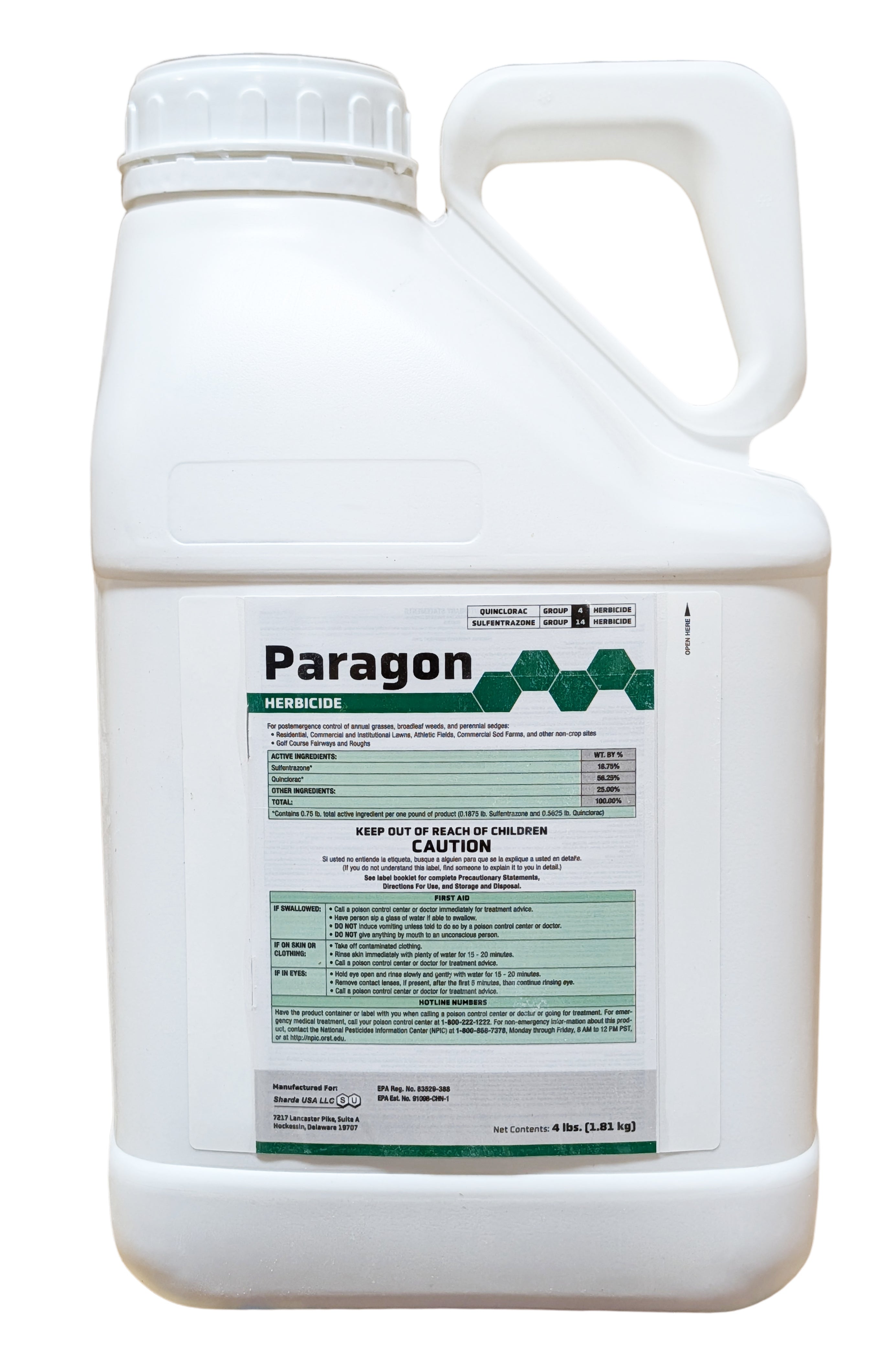
viper granular herbicide Paragon Herbicide for Crabgrass, Nutsedge & KyllingaParagon WDG Herbicide is a professional post emergent herbicide that combines sulfentrazone and quinclorac to provide broad spectrum control of annual grasses, broadleaf weeds, and perennial sedges in a single application. Comparable to Solitare Herbicide, Paragon eliminates the need for tank mixing while delivering powerful control of troublesome weeds such as crabgrass, goosegrass, yellow nutsedge, green kyllinga, clover, ground ivy, dollarweed, and
Paragon WDG Herbicide is a professional post-emergent herbicide that combines sulfentrazone and quinclorac to provide broad-spectrum control of annual grasses, broadleaf weeds, and perennial sedges in a single application. Comparable to Solitare Herbicide, Paragon eliminates the need for tank mixing while delivering powerful control of troublesome weeds such as crabgrass, goosegrass, yellow nutsedge, green kyllinga, clover, ground ivy, dollarweed, and many other difficult-to-control species.
Paragon WDG attacks weeds through both foliage and root uptake, providing rapid visible activity and long-lasting suppression of vegetative reproductive structures. This dual mode of action helps reduce future weed populations while improving turf quality in residential lawns, commercial landscapes, athletic fields, golf course fairways and roughs, and commercial sod farms. With both Group 4 and Group 14 herbicide activity, Paragon provides an excellent resistance management tool for turf professionals.
Features & Benefits
✓ Comparable to Solitare Herbicide from Envu
✓ Controls crabgrass, sedges, kyllinga, and broadleaf weeds in a single application
✓ Contains sulfentrazone and quinclorac for dual-mode weed control
✓ Eliminates the need for multiple herbicides and tank mixes
✓ Controls or suppresses more than 60 turf weeds
✓ Effective on both cool-season and warm-season turfgrass species
✓ Provides post-emergent control of grasses, sedges, and broadleaf weeds
✓ Water-dispersible granule formulation for easy mixing and application
Labeled Use Sites
Residential lawns, commercial turf, institutional turf, athletic fields, sports fields, commercial sod farms, golf course fairways, golf course roughs, parks, recreational turf areas, schools, apartment complexes, office complexes, campgrounds, and other managed turfgrass sites.
Target Weeds
Crabgrass, goosegrass, yellow nutsedge, purple nutsedge, green kyllinga, false green kyllinga, clover, ground ivy, dollarweed, black medic, chickweed, dandelion, henbit, knotweed, kochia, lambsquarters, lespedeza, morningglory, pigweed, plantain, purslane, Florida pusley, smartweed, speedwell, annual spurge, prostrate spurge, spotted spurge, wild violet, woodsorrel, broadleaf signalgrass, foxtail, barnyardgrass, goldenrod, curly dock, deergrass, lawn burweed, pineappleweed, puncturevine, torpedograss, wild garlic, wild onion, Japanese stiltgrass, Star of Bethlehem, and other labeled turf weeds.
Application Notes
Apply Paragon WDG to actively growing weeds shortly after emergence for best results. Applications are most effective when adequate soil moisture is present and no rainfall or irrigation occurs within 24 hours after treatment. If rainfall or irrigation totaling at least 0.5 inch does not occur within 7 days after application, irrigation is recommended.
Use rates range from 16 to 21 oz. per acre depending on target weeds and turf species. Applications should be made with sufficient spray volume to provide thorough coverage. Surfactants are generally not recommended due to the potential for temporary turf discoloration.
Paragon may be applied to established cool-season and warm-season turfgrass species including Kentucky bluegrass, rough bluegrass, tall fescue, perennial ryegrass, buffalograss, centipedegrass, seashore paspalum, zoysiagrass, and bermudagrass.
Product Information
Active Ingredients:
Sulfentrazone 18.75%
Quinclorac 56.25%
HRAC Groups: Group 14 (Sulfentrazone) + Group 4 (Quinclorac)
Chemical Families: PPO Inhibitor + Synthetic Auxin
Formulation: Water Dispersible Granule (WDG)
EPA Reg. No.: 83529-388
Manufacturer: Sharda USA LLC
Generic For: Solitare WDG Herbicide
Shipping Notes
- Free Standard Shipping on $100+ Orders to the USA.
- Except Preorder products are shipped in 48 hours.
- Delivery to the USA:
- Standard Shipping : 3-10 business days
- If time is of the essence, please consider selecting expedited delivery for faster service.
Exchange/Return Notes
- We offer a 30-day return/exchange service after receiving.
- Final sale items are not eligible for returns or exchanges.
- To process your return/exchange, please contact us at [email protected]
- Please click here for more details>>> Return & Exchange Policy