SKU: 81149699306
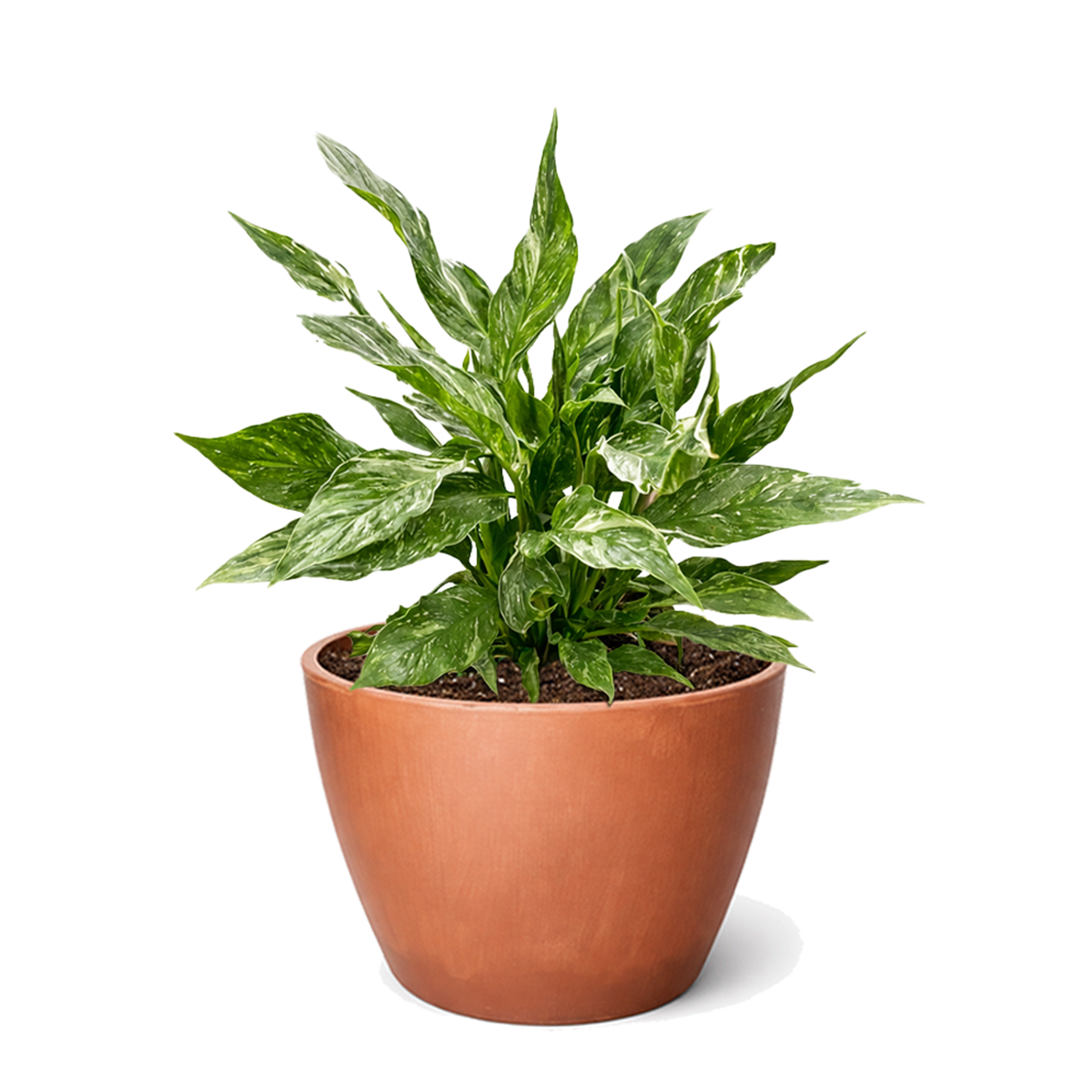
varigated peace lily

varigated peace lily Variegated Spathiphyllum 'Domino' | Rare Ruffled Peace Lily

Sale price$21.11 Regular price$23.46
Save 10%

Pay in installments of $5.87 with ShopPay, AfterPay and Klarna

Shipping Estimate
USA
  • USA
  • CAN

Ships within 48 hours · Estimated delivery Aug 30 - Sep 4

Promo Codes Available:

For Your Every Summer RSVP, with Code: SUMMER15

Description

varigated peace lily Variegated Spathiphyllum 'Domino' | Rare Ruffled Peace LilyDescription Light Soil Water Hardiness The Spathiphyllum 'Domino' is a show stopping cultivar of the traditional Peace Lily. Known for its striking, multi textured appearance, it brings a bold, tropical energy to any indoor collection. Unlike the smooth leaves of its cousins, 'Domino' features a unique, "crinkled" texture and unpredictable splashes of white variegation. What makes 'Domino' truly special is its dramatic variegation and leaf texture.

  • The Spathiphyllum 'Domino' is a show-stopping cultivar of the traditional Peace Lily. Known for its striking, multi-textured appearance, it brings a bold, tropical energy to any indoor collection. Unlike the smooth leaves of its cousins, 'Domino' features a unique, "crinkled" texture and unpredictable splashes of white variegation.

    What makes 'Domino' truly special is its dramatic variegation and leaf texture. Every leaf is a work of art, featuring a "domino" effect of creamy white streaks and speckles against deep, forest-green foliage. Additionally, the leaves have a slightly ruffled or puckered texture, making them feel more substantial and visually complex than the standard glossy varieties.

    A cultivated variety of species native to the tropical rainforests of Central and South America.

    Produces elegant, creamy white spathes on tall stems. They are mildly fragrant and can last for weeks.

    Beyond its looks, this plant is a powerhouse air purifier. It is highly effective at filtering common household toxins like benzene and formaldehyde from the air, making it a functional and beautiful addition to bedrooms and home offices..

  • Prefers medium to bright, indirect light. While it can survive in lower light, its beautiful white variegation may fade to green without enough brightness. Keep it away from direct midday sun to prevent "leaf burn" on the white areas.

    Use a rich, well-draining potting mix. A blend of peat moss, perlite, and a bit of compost is ideal to mimic the forest floor.

    Keep the soil consistently moist. The 'Domino' will literally "tell" you when it's thirsty by drooping its leaves. Water it as soon as the top inch of soil feels dry.

    65°F – 80°F (18°C – 27°C). It loves consistent warmth and high humidity.


  • 11-12 (Grown exclusively as an indoor plant in cooler climates).

Shipping Notes
  • Free Standard Shipping on $100+ Orders to the USA.
  • Except Preorder products are shipped in 48 hours.
  • Delivery to the USA:
  1. Standard Shipping : 3-10 business days
  • If time is of the essence, please consider selecting expedited delivery for faster service.
Exchange/Return Notes
  • We offer a 30-day return/exchange service after receiving.
  • Final sale items are not eligible for returns or exchanges.
  • To process your return/exchange, please contact us at [email protected]
  • Please click here for more details>>> Return & Exchange Policy
SKU: 81149699306

Discover Niche Categories That Outsell varigated peace lily

Top-Converting Item to Boost Your Average Order

4.0 ★★★★★
Based on 29 reviews
Sort
Highest Rating
Newest First
Oldest First
Product Reviews
D
Verified Purchase
DLRinehart
Omaha, US
★★★★★ 5
An important and interesting read; well written and researched
Format: Hardcover
The author uses personal experiences to illustrate and enliven the text. Ms. Bucar challenges us to look at our own reactions, thoughts and practices. I would recommend this book for discussion at my book club.
WAS THIS REVIEW HELPFUL?YesReportShare
Reviewed in the United States on October 1, 2022
M
Madrugada Mistral
Lowell, US
★★★★★ 1
Not what I was hoping for
Format: Paperback
I've been interested in the topic of religious appropriation ever since I saw my non-Tibetan neighbor hang Tibetan prayer flags on his front porch. And when I lived in Japan, I saw that non-Christian Japanese appropriated all of the trappings of Western Christian wedding ceremonies. So I had high hopes for this book. But it reads like a very looooong, and also very academic sermon on the evils of capitalism, western hegemony, and other such terms. There is not an ounce of humor in any of this book.
WAS THIS REVIEW HELPFUL?YesReportShare
Reviewed in the United States on January 25, 2026
B
Verified Purchase
Benjamin Herzog
Battle Creek, US
★★★★★ 5
Fascinating and well written
Format: Hardcover
This is one of those books that makes you re-see everyday things with new awareness and a more critical eye. Well-researched, organized and written. Highly recommend!
WAS THIS REVIEW HELPFUL?YesReportShare
Reviewed in the United States on October 3, 2022
A
And So It Goes
Draper, US
★★★★★ 1
Pop culture: yoga, croases, costumes, tattoos of sacred symbols …is not religious appropiation.
Format: Hardcover
Neither are Christmas trees, a pagan tradition, except to religious fundamentalists. Religion, all religions … which are all patriarchal by origin and definition is to be challenged for hypocrisy … see Madonna for in your face pop blasphemy. This is not scholarship.
WAS THIS REVIEW HELPFUL?YesReportShare
Reviewed in the United States on January 20, 2023
K
Verified Purchase
Keith Hansen
Draper, US
★★★★★ 5
An Invitation to Better Dialogue
Format: Paperback
Perry Schmidt-Leukel has tackled one of the most difficult intellectual minefields of all - religious pluralism. I admire his attempt, desire and intentions. This work is based off of a 2015 Gifford lecture in Glasgow. Religious Pluralism is one of the three possible stances that address the Problem of Religious Diversity. The other two stances are significantly more common and also close sisters - Exclusivism and Inclusivism. Pluralism is the most radical stance but also one most needed in a globally-connected world with seemingly ineradicable conflict and violence. One can safely ignore, by the way, the stance that all religions are nothing but projections of immature minds (Naturalism); this is a gaslighting position which tries to throw the baby out with the bathwater and does not really address the issue of religious diversity. Religion should be treated with the seriousness it is due and humans are inherently homo religiosus as history and culture attest. There are several reasons why Pluralism should be considered the superior stance. First, it is the most pragmatic as alluded to in my above statement on conflict. Second, if one understands Truth as something that no human or group of humans can ever have a monopoly on then Pluralism makes more sense than the other two. I should add that we should approach understanding of Truth more as a peregrination than as some fixed or static destination. Third, much of religious diversity is due to historical, cultural and especially linguistic differences but if we spend time in interreligious dialogue, we can begin to see that the religions are often saying the same things but using different jargon. The jargon should not be confused with Reality or Truth. As humans, we must continually be humbled by our lowly ability to understand reality as it is in itself and our immense limitations of language. Language too often creates division and can also circumscribe our ability to understand. Yet, it is all we really have to communicate with. Perry spends some time first outlining what a program of sustained interreligious dialogue would look like and some foundational principles. He then addresses some of the biggest elephants in the room - The Son, The Prophet and The Buddha - and how we can approach possible reconciliation, or at least how we can begin to frame the discussion. The other main issue is the problem of a Creator God in Buddhism. If I were to offer a point of criticism to Perry's approach it is that he does not include in his discussion Philosophical Religions such as Platonism/Neoplatonism and Panentheism. However, I understand that would have really complicated things and he clearly wanted to only focus on the main traditional religions. Perry then finishes up with a very fresh and thought-provoking discussion on a fractal interpretation of religion. That may be the most profound chapter of the book. The book is full of insight but should be taken as only an overview (albeit a very good one) and a hopeful beginning to more in-depth analysis and discussion. I look forward to reading more from Schmidt-Leukel and I hope more people can move from their exclusivist and inherently conflict-bound view of the world to a more peaceful and uniting view of the very same one reality we are all experiencing and are all a small part of.
WAS THIS REVIEW HELPFUL?YesReportShare
Reviewed in the United States on January 18, 2026

recommand products