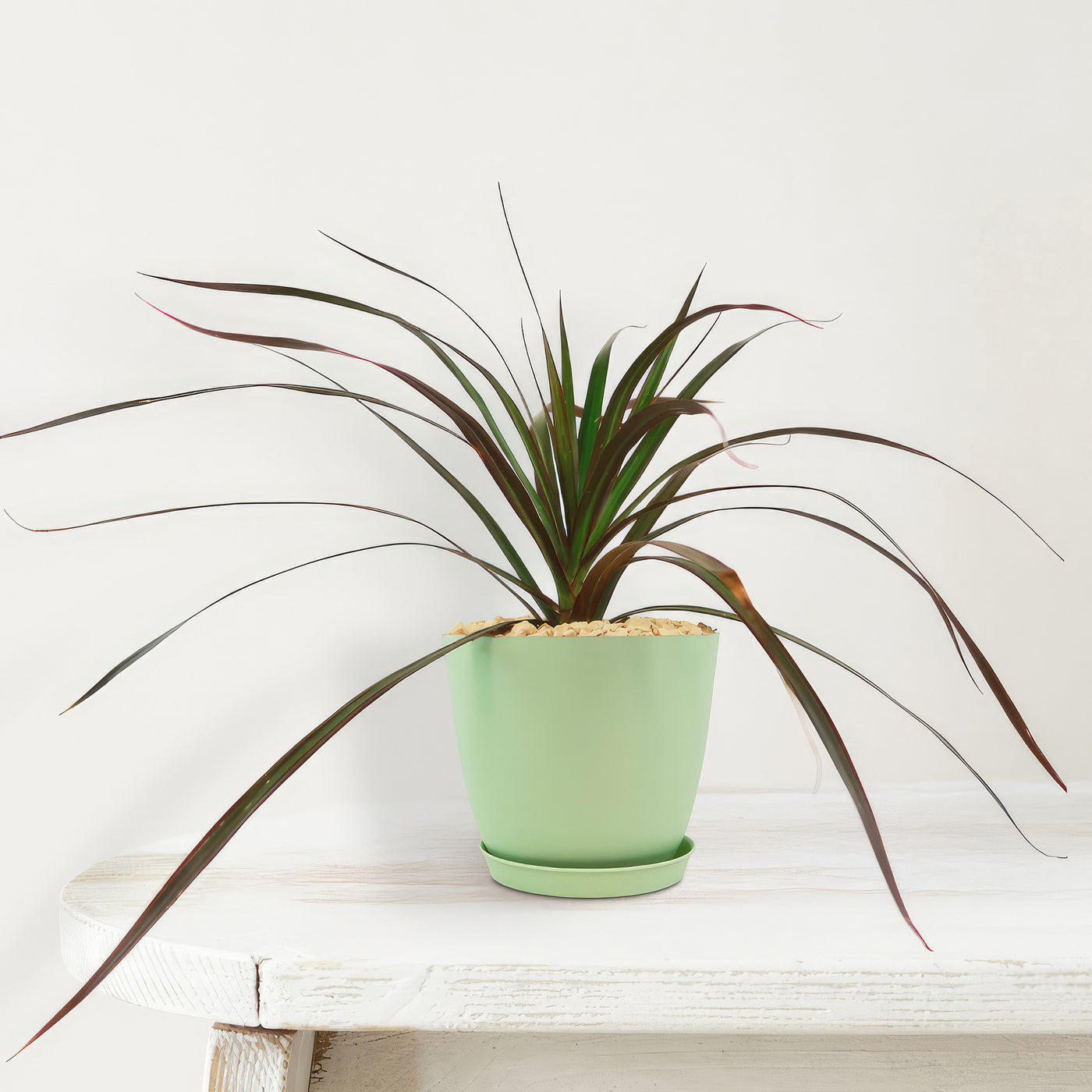
SKU: 89974449876
dracaena marginata air

dracaena marginata air Madagascar Dragon Tree

Sale price$17.98 Regular price$19.98
Save 10%

Pay in installments of $5.00 with ShopPay, AfterPay and Klarna

Shipping Estimate
USA
  • USA
  • CAN

Ships within 48 hours · Estimated delivery Sep 25 - Sep 30

Promo Codes Available:

For Your Every Summer RSVP, with Code: SUMMER15

Description

dracaena marginata air Madagascar Dragon TreeThe Madagascar dragon tree, known as Dracaena marginata Magenta, is a low maintenance, upright houseplant with bold, magenta edged sword like leaves. Its sculptural form and air purifying qualities further enhance its appeal for decor enthusiasts and plant lovers alike. Native to Madagascar, the "Dragon Tree" name comes from the Dracaena genus, known for species that produce red sap resembling "dragons blood", a nod to ancient beliefs and its tree

The Madagascar dragon tree, known as Dracaena marginata ‘Magenta, is a low-maintenance, upright houseplant with bold, magenta-edged sword-like leaves. Its sculptural form and air-purifying qualities further enhance its appeal for decor enthusiasts and plant lovers alike. 

Native to Madagascar, the "Dragon Tree" name comes from the Dracaena genus, known for species that produce red sap resembling "dragon’s blood", a nod to ancient beliefs and its tree-like form with dramatic, spiky leaves. The ‘Magenta’ cultivar is especially prized for the bold pink-to-magenta hue along the leaf margins. 

At maturity, the popular houseplant Dracaena marginata ‘Magenta’ can grow up to 6 feet tall, though it grows slowly and is easy to maintain at a more compact size through pruning.

Outdoors in tropical zones, it may grow even taller to about 20 feet. Its narrow footprint makes it ideal for tight corners, entryways, or flanking furniture pieces.

This vertical growth habit, combined with vivid leaf coloration, gives the plant a strong architectural presence in any space.

The Madagascar dragon tree blooms in spring with small, fragrant white or pale pink flowers.

These star-like flowers typically appear on long panicles, but flowering is uncommon and often limited to outdoor-grown plants in ideal tropical conditions.

Most indoor growers appreciate this plant for its foliage alone, as the colorful leaves are its main ornamental draw.

A unique aspect of the Madagascar Dragon Tree ‘Magenta’ is its exceptional tolerance to drought and low light, making it one of the most forgiving houseplants. It is also known for its air-purifying abilities, having been studied by NASA as one of the top indoor plants for removing toxins such as benzene, formaldehyde, and trichloroethylene from the air. Its durability and ability to bounce back from neglect make it a favorite for both beginners and experienced plant keepers. 

When and How to Water Your Madagascar Dragon Tree 

The drought-tolerant plant stores moisture well and prefers infrequent but thorough watering. Allow the top 1–2 inches of soil to dry out completely before rewatering. Overwatering can lead to root rot, while underwatering is rarely fatal due to its hardy nature. Water your Madagascar Dragon Tree deeply every 10–14 days during the growing season and reduce to every 3–4 weeks during dormancy, ensuring the soil dries out between waterings.

From March through September, during the growing season, water every 10 to 14 days with about 1/4 to 1/2 gallon, depending on pot size and indoor conditions. Ensure water drains freely and avoid leaving the pot in standing water. Humidity can slightly increase watering needs, especially in bright indoor spots. 

From October through February, during the dormant period, reduce watering to every 3 to 4 weeks, using around 1/4 gallon or less. Monitor the soil's dryness before each watering. Lower temperatures and light levels slow growth, so the plant uses significantly less water. 

Light Requirements – Where to Place Your Dracaena marginata 

When grown indoors, place your Madagascar Dragon Tree in bright, indirect light for 6–8 hours daily to maintain vibrant foliage and prevent leggy growth.

Bright east or west-facing windows are ideal, but avoid direct harsh sunlight, which may scorch its leaves.

In lower light, it can survive, but growth may slow, and foliage may dull. Artificial grow lights can supplement natural light in darker rooms.

When grown outdoors, provide dappled sunlight or partial shade with 4–6 hours of morning or filtered sun daily.

Protect it from intense afternoon rays to prevent leaf burning.

A shaded patio or under taller plants can work well for outdoor potted plants during warmer months. Too much sun or too little light will affect appearance and growth. Yellowing leaves may signal excess light, while drooping or sparse foliage indicates insufficient light. Rotate the plant regularly indoors to encourage balanced growth. 

Optimal Soil & Fertilizer Needs 

The Dragon tree prefers a well-drained, loamy or sandy soil with good aeration, and should be fertilized once a year in spring. A high-quality potting mix blended with perlite, bark, or pumice improves drainage and root oxygenation. Instead, make or buy a well-draining potting mix, or ideally use our specialized potting mix, opens in a new tab that contains 5 natural substrates and mycorrhizae to promote the development of a strong root system that helps your dragon plant to thrive. 

Fertilize once a year during spring with a diluted balanced NPK fertilizer with an equal ratio of about 5-10-5. Avoid fertilizing in fall and winter. Overfertilization can damage roots or cause leaf tip burn. If repotting, refresh the soil and avoid compacting it around the roots. Choose a container with drainage holes to maintain optimal root health. 

Indoor Growing Dragon Tree Requirements 

When growing indoors, Madagascar Dragon Trees thrive in warm, humid conditions between 65°F and 80°F with moderate light and consistent care. Maintain humidity above 40%, especially during winter heating. Grouping plants or using a pebble tray can help maintain humidity.

Avoid cold drafts and place the plant near bright windows with filtered sunlight. A location near an east- or west-facing window with sheer curtains is ideal. Harsh direct sun can scorch the leaves, while too little light may cause leggy growth and dull coloration. Rotate the plant every few weeks to encourage even foliage development and prevent it from leaning toward the light source. 

Hardiness Zones & More 

In the United States, this is mostly an indoor plant, but if you live in southern Florida or Hawaii, then you can cultivate it outdoors in USDA zones 10-12.

In these climates, it can be grown as a landscape feature in shaded patios, protected courtyards, or under tall trees that provide dappled sunlight.

The plant cannot tolerate frost or extended cold, so if you're growing it outdoors in cooler zones, it should be moved indoors or into a greenhouse before temperatures drop below 50°F.

In drier climates, they provide extra humidity or misting. Excessive dryness or exposure to the full sun can cause the leaf edges to brown or the color to fade. Regular watering, especially during hot spells, and occasional feeding during the growing season will help maintain its vibrant magenta-striped foliage. 

Wildlife Dragon Tree Flowers Attract the Following Friendly Pollinators 

While not a heavy nectar-producing plant, it can occasionally attract small pollinators like gnats or house flies in humid indoor spaces. Though not a major attractor of wildlife, its presence can complement pollinator-friendly plant groupings in outdoor settings. It typically does not serve as a primary pollinator source. 

According to the ASPCA, Dracaena marginata is mildly toxic to cats and dogs. If ingested in a large amount, it can cause vomiting, drooling, and lethargy. It’s best to keep the plant out of reach of pets, particularly curious kittens or puppies. It is not known to be toxic to birds. 

How to Propagate Your Dracaena marginata 

You can propagate your Madagascar Dragon tree through stem cuttings. Choose a healthy stem, and using sterilized scissors, cut a 4–6-inch segment just below a leaf node. Allow it to dry for a day to prevent rot, then plant the cutting in moist, well-draining soil. Keep it in a warm, bright location with indirect sunlight. Water sparingly until roots develop in about 4–6 weeks. Alternatively, you can root the cutting in water before transplanting it to the soil. 

Key Takeaways

  1. The Madagascar Dragon Tree ‘Magenta’ is a popular houseplant known for its magenta-edged, sword-shaped leaves and architectural appeal.
  2. The plant is highly drought-tolerant, thriving with minimal watering and making it ideal for low-maintenance indoor care.
  3. The growth habit is tall and slender, allowing it to reach 6 feet indoors while taking up very little horizontal space.
  4. The Madagascar Dragon Tree helps purify indoor air, removing harmful toxins like formaldehyde and benzene from your environment.
  5. The plant can be pruned and shaped easily, whether you prefer a bushy form or a single-stemmed, tree-like silhouette.

The Bottom Line 

Overall, the Madagascar Dragon Tree ‘Magenta’ is an easy-care, drought-tolerant plant perfect for beginners and plant lovers alike. With its striking, red-edged foliage and upright growth habit, it makes a bold statement in indoor spaces. It requires only moderate light, infrequent watering, and occasional fertilizing, thriving in warm temperatures and moderate humidity. Ideal for homes and offices, this low-maintenance beauty offers both visual appeal and versatility in containers or grouped arrangements. 

Shipping Notes
  • Free Standard Shipping on $100+ Orders to the USA.
  • Except Preorder products are shipped in 48 hours.
  • Delivery to the USA:
  1. Standard Shipping : 3-10 business days
  • If time is of the essence, please consider selecting expedited delivery for faster service.
Exchange/Return Notes
  • We offer a 30-day return/exchange service after receiving.
  • Final sale items are not eligible for returns or exchanges.
  • To process your return/exchange, please contact us at [email protected]
  • Please click here for more details>>> Return & Exchange Policy
SKU: 89974449876

Discover Niche Categories That Outsell dracaena marginata air

Top-Converting Item to Boost Your Average Order

4.4 ★★★★★
Based on 11 reviews
Sort
Highest Rating
Newest First
Oldest First
Product Reviews
J
Verified Purchase
Jack Hicks
Phoenix, US
★★★★★ 4
interesting science
Format: Hardcover
Under A White Sky, The Nature of The Future, Elizabeth Kolbert, 2021 In 2015 Elizabeth Kolbert won the Pulitzer Prize for her book the Sixth Extinction. In my review of that book, I wrote: Kolbert is not a scientist but a reporter and writer for The New Yorker magazine and as such her book is structured as a series of bylines as she travels around the world reporting on scientists investigating extinctions in both the present and the past. As in that book she adopts the same format but this time investigating “how the very sorts of interventions that have imperiled our planet are increasingly seen as the only hope for its salvation”. Ice cores from the Antarctic and Greenland have shown that the last 10,000 years of earths history have been the most benign and stable climatological periods in the last 100,000 years. During this time, we have been able to develop agriculture, an amazing technological and a pervasive globe encompassing culture with a population now of almost 8 billion people. Without this unusually stable climate most of our current civilization would probably have not evolved or been possible. Up to this point we humans have taken this for granted thinking that this benign state will somehow last forever. In Kolbert’s last book she emphasized that due to our own rapacious destruction of earth’s ecosystems and our destabilization of climate stability, this situation is coming to an end and not responding is not an option. Facing an unimaginable crisis of our own making how should we respond? When we intervene, are we smart enough not to cause newer unanticipated problems greater than the original problem we sought to solve? Kolbert travels around the world seeking an answer to this question. She visits places and examples where we historically have tried to solve problems such as sewage in Chicago or taming floods on the Mississippi only to create larger problems such as invasive species or sinking cities such as New Orleans. The most interesting part of her book is when she addresses the people and places that are using current cutting-edge technology to save ecosystems and reverse global warming. One such example is on the Great Barrier Reef of Australia, one of the most diverse and prolific ecosystems on earth, which is under dire threat from oceanic warming and acidification. Faced with the real possibility of extinction of the reef in just decades, scientists are turning to genetic modification of Corals to make them more resistant to these fast-changing conditions. Since 2012 a new gene editing technology called CRISPR-Cas has become ubiquitous. In fact, so ubiquitous that you can buy your own “genetic engineering home lab kit” from a company in California called Odin for $1800. Kolbert buys her own kit and is able to engineer a colony of E. coli bacteria into a strain that is resistant to streptomycin antibiotic. She then inserts a jellyfish gene into yeast which then glows in the dark. Sound dangerous? Yes, what could possibly go wrong, but this is also the technology to develop new global warming resistant corals or destroy malaria carrying mosquitos, control rapacious rodents on Pacific Islands or control a plague of Cane Toads in Australia, not to mention breakthrough medical benefits. We have so altered natural systems with invasive species, with climatological chaos that the only solution is further intervention. She quotes a scientist at the Australian Animal Health Laboratory: “What people are not seeing is that this is already a genetically altered environment. Invasive species alter the environment by adding entire genomes that don’t belong. By contrast Genetic engineers, by contrast, alter just a few bits of DNA here and there”. “The classic thing people say with molecular biology is: Are you playing God? Well no. We are using our understanding of biological processes to see if we can benefit a system that is in trauma”. Do you feel guilty about all the carbon you are emitting into the atmosphere when you drive around in your SUV or eat a filet mignon? Now there is a way to assuage your guilt. There is a now a company called Climeworks that will do just that for the price of $1000 per ton of sequestered CO2. Being that each American emits about 20 tons per year following the American way of life and to totally assuage your guilt will cost you a cool $20,000 per year. Do you feel that guilty? Kolbert purchases one ton of sequestration and then visits the place where the deed is done which turns out to be at a geothermal power plant in Iceland. There they inject CO2 into the hot molten basalt at the bottom of their well to form limestone. This is a way the earth has been doing this process for millions of years without payment. In fact, it is the very process that transpired when the Himalayas were pushed up by the Indian subcontinent million of years ago, sequestered billions of tons of carbon into limestone and enabled the ice ages to begin 3 million years ago. Is this process a feasible solution to our current crisis? According to the latest UN climate report at this point, some form of sequestration is almost certainly required to avoid a catastrophic global temperature rise above 2 degrees regardless of what green technologies are introduced. Almost certainly the cost of that sequestration will have to be drastically reduced. Is there another way to approach the problem? Here Kolbert interviews scientists who are studying a process called solar geoengineering which involves shooting reflective compounds or crystals into the stratosphere to reflect sun light and reduce the earths albedo or heat absorption. This the same process that occurs when large volcanic explosions expel billions of tons of dust and S02 that block incoming sunlight and cool the planet. Last time a truly global volcanic eruption occurred was Tambora in Indonesia in 1815 and caused catastrophic cooling causing mass famine in various places around the world. Is this a feasible solution? Maybe, certainly not to the extent of Tambora and one side effect might be changing the sky from blue to white and hence the title of the book. Sunsets might be improved however. This a short book and quick read and one gets the sense that it was somewhat truncated because of the pandemic restricting travel. However, there is still a lot of interesting information about the future fate of our planet and what can be done to ameliorate the damage that we have inflicted. JACK
WAS THIS REVIEW HELPFUL?YesReportShare
Reviewed in the United States on March 1, 2021
F
Verified Purchase
Fern
Lowell, US
★★★★★ 5
I like it
Format: Paperback
In very good condition
WAS THIS REVIEW HELPFUL?YesReportShare
Reviewed in the United States on March 25, 2026
M
Verified Purchase
Mr. Stripey
Boise, US
★★★★★ 5
Informative studies of how scientists are trying to address environmental issues today
Format: Paperback
In this book Kolbert travels to visit scientists attempting to address the environmental changes that humans are creating on the planet. The chapters focus on different issues, such as invasive species, and species loss, and includes field site visits, and also references for more reading. If you read this, and Sixth Extinction, and Field Notes From a Catastrophe, you will get a great oversight of some of the environmental issues that we face, although not any neat solutions. All the case studies build up into a wider understanding.
WAS THIS REVIEW HELPFUL?YesReportShare
Reviewed in the United States on December 23, 2023
D
Verified Purchase
Dave of Dublin
West Palm Beach, US
★★★★★ 3
disappointing
Format: Hardcover
I was excited to read "Under a White Sky". Unfortunately, it seems that the author just sort of stopped writing when COVID hit. See page 197, where author laments the arrival of COVID. FOur pages later, book ends. The author even says on page 197: "Here I was, trying to finish a book about the world spinning out of control, only to find the world spinning so far out of control that I couldn't finish the book". Couldn't finish the book, but COULD publish it and sell it to people like me. The early chapters are interesting, each one covering a different topic related to man messing with nature. Good stuff. But I expect some analysis, some conclusion, something to sum it all up. It just isn't there. Topic and early chapters showed great promise. But the ending is truly lacking. And as the author alludes, unfinished.
WAS THIS REVIEW HELPFUL?YesReportShare
Reviewed in the United States on March 7, 2021
I
Verified Purchase
Immer
Grantham, US
★★★★★ 4
As A Dominant Species, We Dance On The Razor’s Edge
Format: Hardcover
Under A White Sky Elizabeth Kolbert’s claim to fame is her book The Sixth Extinction. In comparison Kolbert’s under A White Sky is rather short and disorganized, yet her coverage of those working on solutions to Climate Change is pretty darn interesting.  In her conclusion, she writes, “This has been a book about people trying to solve problems created by people trying to solve problems.” Putting this sentence at the book’s beginning rather than buried at its end would have provided a reader a compass to help determine where Kolbert was going with her dialogue. As she wades through the reversed direction of the Chicago river; Asian carp; Cane toads; forced and accelerated evolution in regard to coral, in particular in regard to the Great Barrier Reef (without discussing the importance of the worlds reefs; the continual flooding of New Orleans both despite and because of the actions of The Army Corps of engineers, one begins to ponder a general connection that might exist, while the book itself is headed toward a two star rating. Then, Kolbert got to Global Warming and Climate science. The book’s last sixty pages are worth the complete price of admission. The chapter begins with carbon sequestration, the pros and cons of how it can be done, and does it also contribute to the growing problem. The stoppered bathtub” analogy is perhaps the best analogy I’ve heard in regard to the anthropocentric carbon dioxide problem on the Earth. The tub is full of water/ the sky’s CO2 level; the tubs stoppered, so the water isn’t going anywhere, and the atmosphere’s increased CO2 level won’t drop in the near future either; and even if the water flow to the tub is reduced, it will still accumulate until over flowing, as will reduced emissions continue to amass in the atmosphere. In a sense, we are already beyond the tipping point in terms of global temperature increase. Harvard University Center for the Environment director Dan Schrag says, “I’m a scientist. My job is not to tell people the good news. My job is to describe the world as accurately as possible.” He predicts, due to the fact that the oceans must equilibriate. “If we were to stop CO2 emissions tomorrow, which of course isn’t possible, it’s still going to warm for centuries. That’s just basic physics.” Thus enters the topic of geoengineering, and the connection with people trying to solve problems created by people trying to solve problems truly comes into focus. Kolbert , in a rather clandestine way connects the dots of her past “local problems”, but now the problem fix, if it doesn’t work could create problems beyond solving. She hits the nail on the head with this. Humans have been around 35-50 thousand years, but only the last ten thousand or so have they thrived, largely due to agriculture and differentiation of what one can do because of agriculture. But ag has only been able to thrive because of the rather consistent global weather of the past ten thousand years, due to glacial retreat. This has been presented in great detail by Jared Diamond in his book Guns, Germs, and Steel. The CO2 we’ve put into the atmosphere isn’t going anywhere, as we continue to pour more into the mix. Her interviews with climate scientists do not bode well for our species, as everything they think of to combat the CO2 conundrum brings more as the bathtub continues to fill. One could say humans have become victims of their own success as a species. Ultimately, one gets the feeling from Kolbert and her interviews, that the enormous fluctuations in the Earth’s climate over geological time, and those yet to come, render whatever we do as humans as a moot point. The Earth will shake is off as a dog rids itself of fleas. She also brings to the argument, when the blank really hits the fan, as it will despite, or because of any preventative efforts by man, the resulting population displacements will be staggering. A sobering, informative book as we, as a species, dance on the razor’s edge.
WAS THIS REVIEW HELPFUL?YesReportShare
Reviewed in the United States on September 24, 2021

recommand products